Purifying the Land of the Pure: A History of Pakistan's Religious Minorities
0
0
As an Amazon Associate and affiliate partner, Menrva Books earns from qualifying purchases. Learn more
Author Description
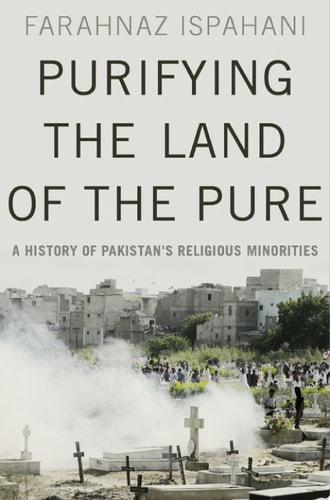
When Pakistan emerged as an independent state in 1947, it sought to provide a new homeland and safe harbor for South Asia's Muslims, the largest religious minority in the subcontinent at the time. Yet this project was not exclusive. Taking its name from Pakstan, an acronym composed of the key letters of its constituent regions-Punjab, Afghania, Kashmir, Sindh, and Baluchistan-Pakistan at first welcomed all of its new citizens, Muslim and non-Muslim alike. Non-Muslims comprised 23 percent of the total population, and non-Sunnis comprised a quarter of the Muslim population.Today, non-Muslims comprise a mere 3 percent of the population, and in recent years all non-Sunnis have been subjected to increasing levels of persecution and violence. What happened?In Purifying the Land of the Pure, Farahnaz Ispahani analyzes Pakistan's policies towards its religious minority populations, beginning from the time of independence in 1947. She notes the period of transition from an inclusive policy to an exclusive one, citing the influence of a number of religious and political leaders who invoked a new vision for Pakistan. The word "pakistan" is Urdu for "Land of the Pure"; thus, in their view, it followed that the objective for Pakistan's creation should be more specific and narrow: to create an Islamic State. In 1949, Pakistan's Constituent Assembly ratified this objective, which set the country on the path it was to follow. But as Ispahani carefully notes, the event that accelerated the pace towards intolerance of non-Sunnis was General Zia-ul-Haq's forceful ascent to power in 1977. His military regime promoted Sunni Islam at the expense of other denominations so that by the end of his reign, Pakistan was no longer a welcome place for minorities. Many fled, but those who remained faced escalating persecution, from both state and non-state actors. Tens of thousands died in the ensuing "purifying" attacks. Ispahani traces this history, stressing how the contradictions at the heart
Menrva's Summary
THE THESIS
This book investigates the historical trajectory of Pakistan's state policies and their role in the systematic marginalization and persecution of religious minorities. Farahnaz Ispahani, a former member of the Pakistani parliament and journalist, utilizes her deep knowledge of the region's political landscape to examine the shift from an inclusive founding vision to an exclusionary Islamic state. She argues that specific legislative actions and military regimes, particularly under General Zia-ul-Haq, institutionalized intolerance and fundamentally altered the nation's demographic and social fabric.
THE SCOPE MAP
What You Will Find
- Historical analysis of Pakistan's legislative evolution from 1947 to the present.
- Examination of the influence of religious and political leaders on state identity.
- Documentation of the decline of non-Muslim and non-Sunni populations.
- Assessment of the impact of the 1949 Objectives Resolution and the 1977 military coup.
Scope Limits
- The text focuses primarily on state-level policy and institutional shifts rather than individual biographical accounts of every affected minority group.
- It does not provide an exhaustive sociological study of every specific local community, prioritizing the national political narrative.
THE AUTHORITY PERSPECTIVE
Experts and scholars of South Asian history frequently cite this work as a critical, well-documented account of the institutionalization of religious intolerance in Pakistan. Readers often note the academic rigor and the sobering clarity with which the author connects historical policy decisions to contemporary human rights challenges.
Page Count:
224
Publication Date:
2017-01-01
Publisher:
Oxford University Press
ISBN-10:
0190621672
ISBN-13:
9780190621674
Religion
History
Asian Studies
Sociology
Pakistan
Human rights
Community Tags
Similar Books