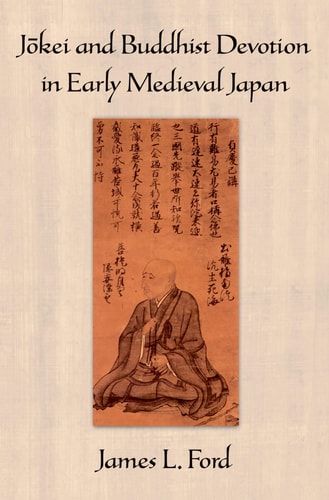
J-okei and Buddhist Devotion in Early Medieval Japan
0
0
As an Amazon Associate and affiliate partner, Menrva Books earns from qualifying purchases. Learn more
Author Description
This is the first book-length study in any language of Jō kei (1155-1213), a prominent Buddhist cleric of the Hossō (Yogācāra) school, whose life bridged the momentous transition from Heian (794-1185) to Kamakura (1185-1333) Japan. "Kamakura Buddhism" has drawn notable scholarly attention, largely because it marks the emergence of new schools-Pure Land, Nichiren, and Zen-that came to dominate the Buddhist landscape of Japan. Although Jōkei is invariably cited as one of the leading representatives of established Buddhism during the Kamakura period, he has been seriously neglected by Western scholars.In this book, James L. Ford aims to shed light on this pivotal and long-overlooked figure. Ford argues convincingly that Jōkei is an ideal personage through which to peer anew into the socio-religious dynamics of early medieval Japan. Indeed, Jōkei is uniquely linked to a number of decisive trends and issues of dispute including: the conflict between the established schools and Hōnen's exclusive nenbutsu movement; the precept-revival movement; doctrinal reform efforts; the proliferation of prominent "reclusive monks" (tonseisō); the escalation of fundraising (kanjin) campaigns and popular propagation; and the conspicuous revival of devotion toward Śákyamuni and Maitreya. Jōkei represents a paradigm within established Buddhism that recognized the necessity of accessing other powers through esoteric practices, ritual performances, and objects of devotion. While Jōkei is best known as a leading critic of Hōnen's exclusive nenbutsu movement and a conservative defender of normative Buddhist principles, he was also a progressive reformer in his own right. Far from defending the status quo, Jōkei envisioned a more accessible, harmonious, and monastically upright form of Buddhism.Through a detailed examination of Jōkei's extensive writings and activities, Ford challenges many received interpretations of Jōkei's legacy and the transformation of Buddhism in early medieval Japan. Th
Menrva's Summary
THE THESIS
This study investigates the life and religious contributions of the Buddhist cleric Jōkei to determine his role in the transition between the Heian and Kamakura periods in Japan. James L. Ford, a scholar of Japanese religious history, utilizes Jōkei's extensive writings and historical records to challenge the traditional view of him as merely a conservative critic of new Buddhist movements. Ford argues that Jōkei was a progressive reformer who sought to revitalize established Buddhism through precept reform, ritual performance, and a renewed focus on devotion to Śākyamuni and Maitreya.
THE SCOPE MAP
What You Will Find
- Analysis of the socio-religious dynamics during the transition from the Heian to the Kamakura period.
- Examination of the conflict between established Buddhist schools and the rise of the exclusive nenbutsu movement.
- Detailed review of Jōkei's efforts in the precept-revival movement and fundraising campaigns.
- Evaluation of the role of reclusive monks and doctrinal reform within medieval Japanese Buddhism.
THE AUTHORITY PERSPECTIVE
Scholars recognize this work as the first comprehensive study of Jōkei in any language, filling a significant gap in Western academic literature regarding established Buddhism in medieval Japan. Experts highlight the text as a necessary resource for understanding the complexities of religious reform and institutional continuity during a period often defined by the emergence of new Buddhist schools.
Page Count:
336
Publication Date:
2006-08-24
Publisher:
Oxford University Press
ISBN-10:
0195188144
ISBN-13:
9780195188141
Religion
Biography
History
Buddhism
Japan
Buddhism history
Buddhism_japan
Community Tags
Similar Books