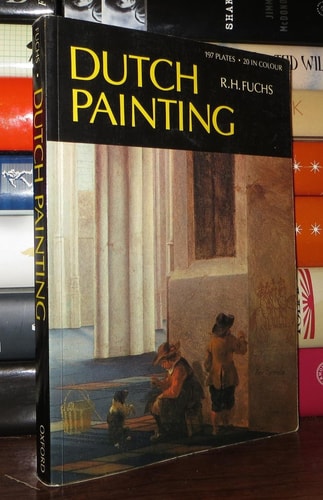
Dutch Painting
0
0
As an Amazon Associate and affiliate partner, Menrva Books earns from qualifying purchases. Learn more
Author Description
Dutch art spans the history of Western easel painting from the Middle Ages to the present, and has a psychological development of its own which makes it a fascinating field of study. With a fresh and critical eye, Fuchs reviews its evolution from the foundation of Netherlandish realism in the fifteenth century with the Van Eycks, through the elevated style of Renaissance history painting, the language of symbols of the seventeenth century and the work of its masters--Claesz's still-lifes, the portraits of Hals and Rembrandt, and Ruisdael's landscapes--and on through eighteenth- and nineteenth-century realism, right up to Van Gogh's pioneering Expressionism, the radical simplification of Mondrian, and the art of Dibbets and Brouwn. 197 illus., 20 in color.
Menrva's Summary
THE THESIS
This work investigates the psychological and stylistic evolution of Dutch easel painting from the medieval period through the late twentieth century. Rudolf Herman Fuchs, a noted art historian and museum director, utilizes a critical framework to examine how Netherlandish realism transformed into the distinct visual languages of the Renaissance, the Golden Age, and modern Expressionism. By tracing the lineage of masters from the Van Eycks to Mondrian, the author argues that Dutch art possesses a unique internal development that reflects broader shifts in Western aesthetic values.
THE SCOPE MAP
What You Will Find
- A comprehensive survey of Dutch art history spanning from the fifteenth century to the modern era.
- Analysis of key movements including Netherlandish realism, Renaissance history painting, and seventeenth-century symbolism.
- Critical evaluations of major figures such as Rembrandt, Hals, Ruisdael, Van Gogh, and Mondrian.
- A collection of 197 illustrations, including 20 in color, to support the historical and stylistic arguments.
THE AUTHORITY PERSPECTIVE
Experts and art historians frequently cite this text as a concise and insightful overview of the Dutch tradition. Readers often note that the prose is accessible yet maintains a high level of scholarly rigor, making it a standard reference for those interested in the development of European painting.
Page Count:
216
Publication Date:
1978-01-01
Publisher:
Oxford Univ Pr
ISBN-10:
0195200616
ISBN-13:
9780195200614
Non-Fiction
Art History
Painting
Painting Dutch
European Art