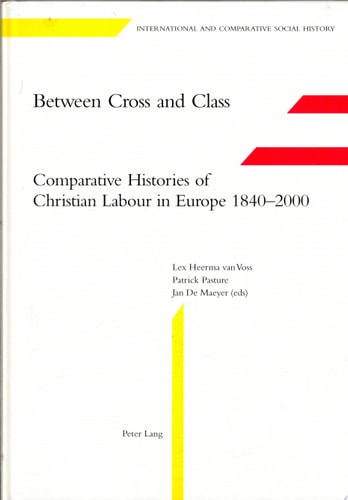
Between Cross and Class: Comparative Histories of Christian Labour in Europe 1840-2000
0
0
As an Amazon Associate and affiliate partner, Menrva Books earns from qualifying purchases. Learn more
Author Description
In the late nineteenth century in a number of continental European countries Christian associations of workers arose: Christian trade unions, workers' cooperatives, political leagues, workers' youth movements and cultural associations, sometimes separately for men and women. In some countries they formed a unified Christian labour movement, which sometimes also belonged to a broader Christian subculture or pillar, encompassing all social classes. In traditional labour history Christian workers' organizations were solely represented as dividing the working class and weakening the class struggle. However, from the 1980s onwards a considerable amount of studies have been devoted to Christian workers' organizations that adopted a more nuanced approach. This book takes stock of this new historiography. To broaden the analysis, each contribution compares the development in at least two countries, thus generating new comparative insights. This volume assesses the development of Christian workers' organizations in Europe from a broad historical and comparative perspective. The contributions focus on the collective identity of the Christian workers' organization, their denominational and working-class allegiances and how these are expressed in ideology, organization and practice. Among the themes discussed are relations with churches and Christian Democracy, secularization, the development of the Welfare State, industrial relations and the contribution to working-class culture. This volume is the result of a joint intellectual enterprise of the International Institute of Social History (IISG) in Amsterdam (Netherlands) and a group of scholars linked to the KADOC - Documentation and Research Centre for Religion, Culture and Society of the KU Leuven (Catholic University Leuven-Belgium).
Menrva's Summary
THE THESIS
This book examines the historical development and comparative analysis of Christian labor organizations across Europe from 1840 to 2000. It synthesizes recent historiography on these movements, which previously were often viewed solely as divisive forces within the working class. The volume explores the collective identity, denominational and working-class allegiances, and ideological expressions of these organizations, drawing on comparative insights from at least two countries per contribution.
THE SCOPE MAP
- Comparative analysis of Christian trade unions, workers' cooperatives, political leagues, and cultural associations in various European countries.
- Exploration of the collective identity and allegiances (denominational and working-class) of Christian workers' organizations.
- Discussion of the relationship between these organizations, churches, and Christian Democracy.
- Analysis of themes including secularization, the development of the Welfare State, industrial relations, and contributions to working-class culture.
- Insights derived from a joint intellectual enterprise between the International Institute of Social History (IISG) and KADOC
- Documentation and Research Centre for Religion, Culture and Society.
THE AUTHORITY PERSPECTIVE
This volume is the result of a joint intellectual enterprise by the International Institute of Social History and KADOC, bringing together scholars to assess the development of Christian workers' organizations in Europe from a broad historical and comparative perspective. The contributions focus on collective identity, denominational and working-class allegiances, and their expression in ideology, organization, and practice. Themes discussed include relations with churches and Christian Democracy, secularization, the development of the Welfare State, industrial relations, and the contribution to working-class culture. The book takes stock of new historiography that offers a more nuanced approach to these organizations.
Page Count:
399
Publication Date:
2005-01-01
Publisher:
Peter Lang
ISBN-10:
3039100440
ISBN-13:
9783039100446
History
Non-Fiction
Religious History
European History
Labor history
Social History
Community Tags
Similar Books