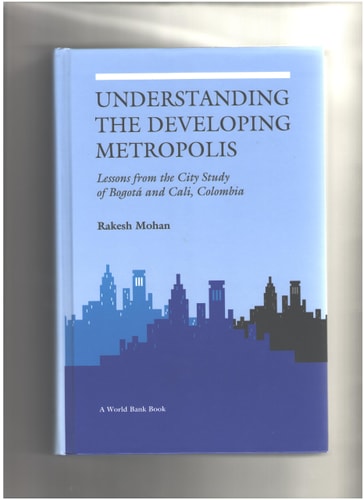
Understanding the Developing Metropolis: Lessons from the City Study of Bogotá and Cali, Colombia
0
0
As an Amazon Associate and affiliate partner, Menrva Books earns from qualifying purchases. Learn more
Author Description
This third and final volume from the City Study analyzes the structure of Bogota and Cali, Colombia by modelling different markets and the behavior of individuals, households, firms, and governments within these markets. Simple economic reasoning is used to understand the urban behavior that can determine a city's overall appearance and structure. The author underlines the importance of this understanding which, he argues, could lead to the creation of more effective urban policies. This study links infrastructure requirements and supply to the behavior of urban life and to the existing income distribution in the city. The author concludes that institutional responses to the rapidly changing and unpredictable demands of metropolitan residents must become an inherent part of city structure, and that this would be the most practical way of coping with urban growth.
Menrva's Summary
THE THESIS
This work investigates how the economic behavior of individuals, households, firms, and governments shapes the physical structure and development of rapidly growing metropolitan areas. Rakesh Mohan, an economist with extensive experience in urban development, utilizes data from the City Study of Bogotá and Cali to construct a framework for understanding urban evolution. By applying economic reasoning to infrastructure supply and income distribution, the author argues that urban policy must be inherently adaptive to the unpredictable demands of city residents to manage growth effectively.
THE SCOPE MAP
What You Will Find
- Economic modeling of market behaviors in Bogotá and Cali, Colombia.
- Analysis of the relationship between infrastructure requirements and urban income distribution.
- Methodologies for linking individual and firm decision-making to city-wide structural outcomes.
- Policy recommendations for institutional responses to metropolitan growth.
THE AUTHORITY PERSPECTIVE
Experts recognize this text as a foundational case study in urban economics and development planning. Readers frequently note the technical clarity of the economic models, which provide a practical framework for analyzing metropolitan growth in developing nations.
Page Count:
344
Publication Date:
1994-07-21
Publisher:
Oxford University Press
ISBN-10:
019520882X
ISBN-13:
9780195208825
Economics
Public Policy
Urban policy
Sociology
urban planning
Community Tags
Similar Books