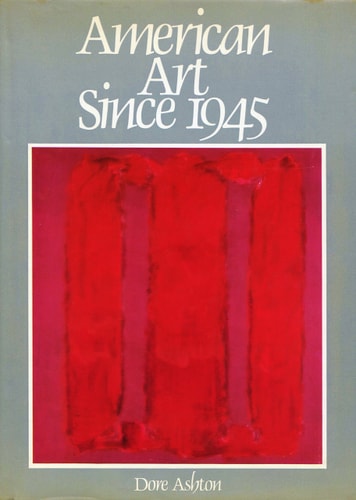
American Art Since 1945
0
0
As an Amazon Associate and affiliate partner, Menrva Books earns from qualifying purchases. Learn more
Author Description
Traces the origins of Abstract Expressionism in all its early revolutionary impact, and reconstructs subsequent transitions into other forms of abstraction, to minimal and conceptual art, to Pop art, to various anti-art forms, and back to most recent traditional realistic styles.
Menrva's Summary
THE THESIS
This text investigates the evolution of American visual arts from the post-World War II era to the late twentieth century, questioning how shifting cultural priorities influenced aesthetic movements. Dore Ashton, a prominent art critic and historian, utilizes her extensive background in mid-century art criticism to analyze the transition from Abstract Expressionism to subsequent movements. She provides a structured examination of the ideological shifts that propelled artists toward minimalism, conceptualism, and eventually, a return to realism. The work serves as a comprehensive survey of the artistic landscape during a period of rapid social and political change in the United States.
THE SCOPE MAP
What You Will Find
- Detailed analysis of the rise and impact of Abstract Expressionism.
- Chronological documentation of transitions into Pop art and conceptualism.
- Examination of the emergence of anti-art movements and their influence on traditional styles.
- Critical assessment of the resurgence of realistic styles in the late twentieth century.
THE AUTHORITY PERSPECTIVE
Experts recognize this work as a foundational text for understanding the trajectory of American art in the post-war period. Readers frequently note the academic density of the prose, which provides a rigorous framework for students and scholars of art history.
Page Count:
224
Publication Date:
1982-03-25
Publisher:
Oxford University Press
ISBN-10:
0195203593
ISBN-13:
9780195203592
Non-Fiction
Art american
Modern Art
Contemporary Art
American Art
Art History