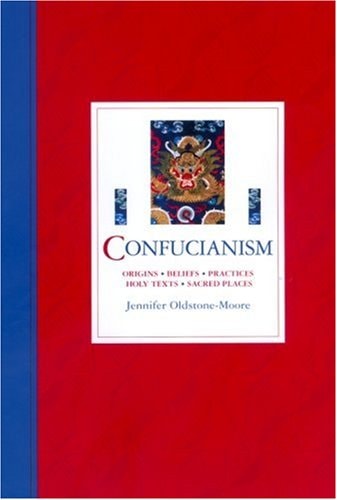
Confucianism
0
0
As an Amazon Associate and affiliate partner, Menrva Books earns from qualifying purchases. Learn more
Author Description
Six centuries before the birth of Jesus, a Chinese sage named Master Kong or Kong Fuzi (later latinized to Confucius) drafted the principles of a society founded upon virtue. For more than two thousand years, Kong Fuzi's work has remained the foundation of Chinese civilization.In this lavishly illustrated volume, Jennifer Oldstone-Moore takes readers on an insightful tour of this enduring belief system. Not quite a religion, more than a philosophy, Confucianism coexists with Daoism and Buddhism in Chinese spiritual life, guiding personal relations and social structure. Oldstone-Moore explains the essence of Confucian belief--the primary importance of filial relations, and the need for governments to be founded upon virtue--and she underscores the overarching importance of the Confucian canon. Though Confucius's own sayings are preserved in the Analects, he saw himself as an editor and mediator of the wisdom of antiquity, which he gathered in the Six Classics and Four Books, which stress harmony in the social order. The author sheds much light on these texts--The Book of Changes, the Classic of History, the Classic of Poetry, the Spring and Autumn Annals, the Book of Rites, and the now-lost Classic of Music--and also discusses the role of heroes (such as the Sage Kings), rituals and the Chinese calendar, sacred places, and Confucianism's place as a state religion through much of Chinese history.No society on earth has had the continuous history--as a single people, culture, and state--that China enjoys. One of the keys to that unity, to China's very identity, is Confucianism, deftly elucidated in this attractive, informative volume.
Menrva's Summary
THE THESIS
This volume investigates the foundational role of Confucianism in shaping the social, political, and spiritual identity of Chinese civilization over two millennia. Jennifer Oldstone-Moore, a scholar of East Asian religions, utilizes historical analysis and textual examination to argue that Confucianism functions as a vital framework for personal ethics and state governance. By exploring the transition from the teachings of Master Kong to the institutionalization of the Confucian canon, the author provides a comprehensive overview of how these principles established a lasting social order.
THE SCOPE MAP
What You Will Find
- An analysis of the Six Classics and Four Books, including the Analects and the Book of Rites.
- Historical context regarding the integration of Confucianism as a state-sanctioned belief system.
- Examination of the interplay between Confucianism, Daoism, and Buddhism within Chinese spiritual life.
- Discussion of the importance of filial piety, ritual practice, and the role of the Sage Kings in maintaining social harmony.
THE AUTHORITY PERSPECTIVE
Experts and readers recognize this work as an accessible and visually engaging introduction to the complexities of Confucian thought. The text is frequently cited for its ability to distill dense philosophical concepts into a clear narrative suitable for those seeking a foundational understanding of Chinese cultural history.
Page Count:
112
Publication Date:
2002-11-07
Publisher:
Oxford University Press
ISBN-10:
0195219082
ISBN-13:
9780195219081
History
Philosophy
Religion
Chinese History
Confucianism
Asian History
Community Tags
Similar Books