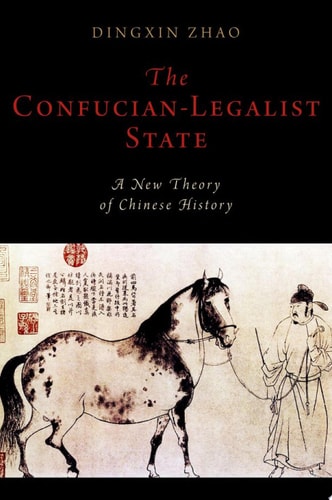
The Confucian-Legalist State: A New Theory of Chinese History
0
0
As an Amazon Associate and affiliate partner, Menrva Books earns from qualifying purchases. Learn more
Author Description
In The Confucian-Legalist State, Dingxin Zhao offers a radically new analysis of Chinese imperial history from the eleventh century BCE to the fall of the Qing dynasty. This study first uncovers the factors that explain how, and why, China developed into a bureaucratic empire under the Qin dynasty in 221 BCE. It then examines the political system that crystallized during the Western Han dynasty, a system that drew on China's philosophical traditions of Confucianism and Legalism. Despite great changes in China's demography, religion, technology, and socioeconomic structures, this Confucian-Legalist political system survived for over two millennia. Yet, it was precisely because of the system's resilience that China, for better or worse, did not develop industrial capitalism as Western Europe did, notwithstanding China's economic prosperity and technological sophistication beginning with the Northern Song dynasty. In examining the nature of this political system, Zhao offers a new way of viewing Chinese history, one that emphasizes the importance of structural forces and social mechanisms in shaping historical dynamics. As a work of historical sociology, The Confucian-Legalist State aims to show how the patterns of Chinese history were not shaped by any single force, but instead by meaningful activities of social actors which were greatly constrained by, and at the same time reproduced and modified, the constellations of political, economic, military, and ideological forces. This book thus offers a startling new understanding of long-term patterns of Chinese history, one that should trigger debates for years to come among historians, political scientists, and sociologists.
Menrva's Summary
THE THESIS
This book investigates the structural mechanisms that allowed the Confucian-Legalist political system to persist in China for over two millennia while simultaneously preventing the development of industrial capitalism. Dingxin Zhao, a scholar of historical sociology, utilizes a framework that emphasizes the interplay between social actors and the constellations of political, economic, military, and ideological forces. By analyzing the transition from the Western Zhou to the Qin dynasty and the subsequent crystallization of the imperial state, Zhao argues that historical patterns were shaped by structural constraints rather than a single deterministic force. The text provides a comprehensive re-evaluation of Chinese imperial history from the eleventh century BCE through the end of the Qing dynasty.
THE SCOPE MAP
What You Will Find
- A structural analysis of the bureaucratic empire established in 221 BCE.
- An examination of the synthesis between Confucian ideology and Legalist political practice.
- A comparative perspective on why China diverged from the path of Western European industrial capitalism.
- An application of historical sociology to long-term state development.
Scope Limits
- The analysis focuses primarily on structural and institutional dynamics rather than detailed biographical accounts of individual emperors.
- The study concludes with the fall of the Qing dynasty and does not extend into the modern era of the People's Republic of China.
THE AUTHORITY PERSPECTIVE
Scholars and historians recognize this work as a significant contribution to the field of historical sociology, noting its rigorous approach to institutional persistence. Readers frequently highlight the density of the prose and the complexity of the theoretical framework, making it a text primarily suited for academic audiences and advanced students of Chinese history.
Page Count:
465
Publication Date:
2015-01-01
Publisher:
Oxford University Press
ISBN-10:
0190463619
ISBN-13:
9780190463618
History
Philosophy history
Sociology
History of the Americas
Imperial China
Historical Sociology
Chinese History
European History
Asian History
China
Community Tags
Other Editions(2)
Similar Books