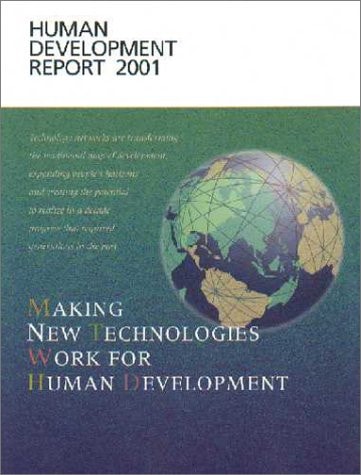
Human Development Report 2001: Making New Technologies Work for Human Development (Human Development Report (Paperback))
0
0
As an Amazon Associate and affiliate partner, Menrva Books earns from qualifying purchases. Learn more
Author Description
The Human Development Report 2001, commissioned by the United Nations Development Programme (UNDP), is the latest annual installment in a series devoted to shifting the development debate away from a sole concern with economic growth toward a balanced concern for equity, sustainability, and empowerment. Now published in 13 languages, the Report features a wide variety of national development indicators for 162 countries including demographic trends, education levels, gender disparities, and macroeconomic indicators. The Report's Human Development Index now serves as a successful complement to GNP as a measure of overall development.This year's Report tackles the theme of how to make new technologies--such as information and communications technologies and biotech--work for human development. While the potential rewards are tremendous, access to these technologies is still deeply divided. Some 2 billion people do not even have access to the most basic medicines such as penicillin, and four-fifths of all Internet users are found in the world's richest countries. The Report examines some of today's controversial policy issues: the risks and benefits of genetically-modified "frankenfoods," "brain drain" of highly-educated workers from developing countries, patents and other intellectual property issues and much more. And it provides recommendations for national technology policy, international initiatives and fairer global rules that will make the network age an age of opportunity for all.
Menrva's Summary
THE THESIS
This report investigates how emerging technological advancements, specifically in information technology and biotechnology, can be harnessed to foster equitable human development rather than exacerbating global inequality. The United Nations Development Programme (UNDP) utilizes a team of international experts and economists to analyze the current state of global technological access. By contrasting the potential benefits of innovation with the reality of the digital and medical divide, the report argues for policy frameworks that prioritize human well-being over purely economic metrics.
THE SCOPE MAP
What You Will Find
- Comprehensive statistical data on 162 countries, including demographic, educational, and macroeconomic indicators.
- Analysis of the Human Development Index (HDI) as a primary metric for assessing national progress.
- Examination of controversial policy issues including intellectual property rights, genetically modified organisms, and the migration of skilled labor.
- Strategic recommendations for national technology policies and international cooperation to bridge the global digital divide.
THE AUTHORITY PERSPECTIVE
Experts and policymakers frequently cite this report as a foundational document for understanding the intersection of global technology policy and human rights. Readers often note the high density of statistical data and the report's utility as a standard reference for international development studies.
Page Count:
278
Publication Date:
2001-07-12
Publisher:
Oxford University Press
ISBN-10:
0195218353
ISBN-13:
9780195218350
Economics
Sociology
Technology
Global Studies
Public Policy
Developmental Psychology
International Development
Community Tags
Similar Books