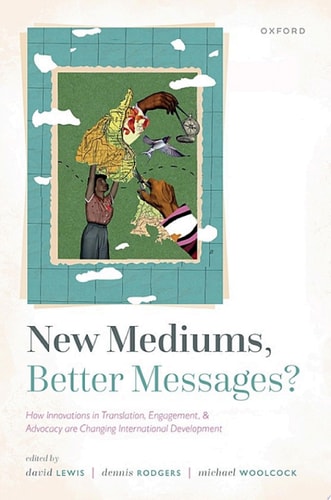
New Mediums, Better Messages?: How Innovations in Translation, Engagement, and Advocacy are Changing International Development
0
0
As an Amazon Associate and affiliate partner, Menrva Books earns from qualifying purchases. Learn more
Author Description
This is an open access title available under the terms of a CC BY 3.0 IGO International licence. It is free to read at Oxford Scholarship Online and offered as a free PDF download from OUP and selected open access locations. The notion of development influences and is influenced by all aspects of human life. Social science is but one representational option among many for conveying the myriad ways in which development is conceived, encountered, experienced, justified, courted, and/or resisted by different groups at particular times and places. As international development has become more quantitative and economics-centred, there is an enduring sense that what is measured (and thus 'valued' and prioritized) may have become too narrow, that the powers of prediction claimed by some areas of economics and management may have overreached, and that the human dimension is in danger of being lost. Reflecting this concern, New Mediums, Better Messages? contributes to new conversations between science, social science, and the humanities around the roles of different kinds of knowledge, stories, and data play in relation to global development. It brings together a team of multidisciplinary contributors to explore popular representions of development, including music, blogs, and fiction.
Menrva's Summary
THE THESIS
This book investigates whether diversifying the mediums used to communicate international development—beyond traditional quantitative social science—can better capture the human dimension of global progress. David F. V. Lewis, an expert in development studies, assembles a multidisciplinary team to challenge the dominance of economics-centered metrics. The authors argue that current development discourse often neglects the lived experience of populations, proposing that integrating narratives from music, literature, and digital media provides a more comprehensive understanding of how development is perceived and resisted.
THE SCOPE MAP
What You Will Find
- Analysis of non-traditional communication channels including music, blogs, and fiction.
- Theoretical frameworks for bridging the gap between science, social science, and the humanities.
- Critical evaluation of quantitative-heavy development metrics and their limitations.
Scope Limits
- The text does not provide a technical manual for implementing specific development projects.
- It does not offer a comprehensive history of international development policy.
THE AUTHORITY PERSPECTIVE
Experts recognize this work as a significant contribution to the critique of neoliberal development paradigms. Readers often note that the prose is accessible to academics across disciplines while providing a necessary challenge to standard economic reporting methods.
Page Count:
450
Publication Date:
2022-01-01
Publisher:
OUP Oxford
ISBN-10:
0192602411
ISBN-13:
9780192602411
Social Science
International Development
Sociology
Global Studies
Communication Studies
Humanities
Community Tags
Similar Books