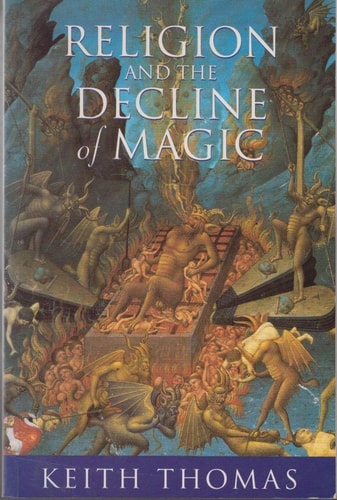
Religion and the Decline of Magic: Studies in Popular Beliefs in Sixteenth and Seventeenth Century England
0
0
As an Amazon Associate and affiliate partner, Menrva Books earns from qualifying purchases. Learn more
Author Description
Astrology, witchcraft, magical healing, divination, ancient prophecies, ghosts, and fairies were taken very seriously by people at all social and economic levels in sixteenth- and seventeenth-century England. Helplessness in the face of disease and human disaster helped to perpetuate this belief in magic and the supernatural. As Keith Thomas shows, England during these years resembled in many ways today's "underdeveloped areas." The English population was exceedingly liable to pain, sickness, and premature death; many were illiterate; epidemics such as the bubonic plague plowed through English towns, at times cutting the number of London's inhabitants by a sixth; fire was a constant threat; the food supply was precarious; and for most diseases there was no effective medical remedy.In this fascinating and detailed book, Keith Thomas shows how magic, like the medieval Church, offered an explanation for misfortune and a means of redress in times of adversity. The supernatural thus had its own practical utility in daily life. Some forms of magic were challenged by the Protestant Reformation, but only with the increased search for scientific explanation of the universe did the English people begin to abandon their recourse to the supernatural.Science and technology have made us less vulnerable to some of the hazards which confronted the people of the past. Yet Religion and the Decline of Magic concludes that "if magic is defined as the employment of ineffective techniques to allay anxiety when effective ones are not available, then we must recognize that no society will ever be free from it."
Menrva's Summary
THE THESIS
This work investigates the functional role of magical beliefs in sixteenth- and seventeenth-century England and the subsequent decline of these practices as scientific rationalism emerged. Sir Keith Thomas, a distinguished historian, utilizes an extensive array of primary sources, including diaries, court records, and contemporary literature, to construct a comprehensive social history. He argues that magic served as a practical, albeit ineffective, mechanism for individuals to manage anxiety and misfortune in a society plagued by disease, poverty, and limited medical knowledge. By framing magic as a response to environmental and physical vulnerability, Thomas provides a framework for understanding how belief systems evolve alongside technological and scientific progress.
THE SCOPE MAP
What You Will Find
- Analysis of popular beliefs including astrology, witchcraft, divination, and supernatural entities.
- Examination of the intersection between the Protestant Reformation and traditional magical practices.
- Extensive use of historical primary source documentation from the Tudor and Stuart periods.
- A sociological framework defining magic as a coping mechanism for human vulnerability.
THE AUTHORITY PERSPECTIVE
Historians and sociologists frequently cite this text as a foundational study in the social history of early modern England. Readers often note the academic density of the prose, which provides a rigorous and exhaustive examination of the period's belief structures.
Page Count:
716
Publication Date:
1997-08-14
Publisher:
Oxford University Press
ISBN-10:
0195213602
ISBN-13:
9780195213607
History
Religion
Sociology
Occultism
Folklore
Great Britain