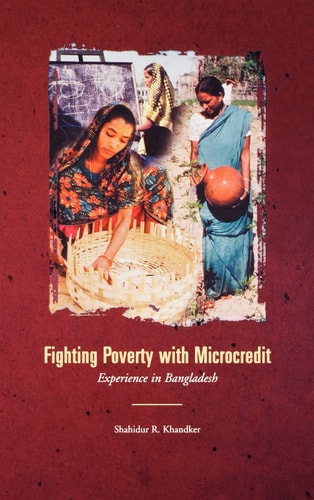
Fighting Poverty with Microcredit: Experience in Bangladesh
0
0
As an Amazon Associate and affiliate partner, Menrva Books earns from qualifying purchases. Learn more
Author Description
With increasing assistance from the World Bank and other donors, microfinance is emerging as an instrument for reducing poverty and improving the poor's access to financial services in low-income countries. Providing the poor with access to financial services is one of many ways to help increase their incomes and productivity. In many countries, however, traditional financial institutions have failed to provide this service. Microcredit and cooperative programs fill this gap. They provide credit through social mechanisms such as group-based lending to reach the poor and other clients, including women, who lack access to formal financial institutions. Their purpose is to help the poor become self-employed and thus escape poverty. This book examines the experiences of the Grameen Bank, the Bangladesh Rural Advancement Committee, and the Bangladesh Rural Development Board's Rural Development Project-12 in order to quantify the potential and limitations of microcredit programs as an instrument for reducing poverty and delivering financial services to the poor. A copublication of the World Bank and Oxford University Press.
Menrva's Summary
THE THESIS
Can microcredit programs effectively reduce poverty and increase productivity among the rural poor in low-income nations? Shahidur Khandker, a senior economist at the World Bank, utilizes extensive empirical data from three major Bangladeshi microfinance institutions to evaluate the efficacy of group-based lending. The text provides a rigorous quantitative analysis of how these financial mechanisms influence household income, self-employment, and access to capital for marginalized populations, particularly women.
THE SCOPE MAP
What You Will Find
- Quantitative analysis of Grameen Bank, BRAC, and RD-12 programs
- Evaluation of group-based lending as a social mechanism for financial inclusion
- Assessment of microcredit impact on household income and productivity
- Comparative study of institutional limitations and potential in rural development
THE AUTHORITY PERSPECTIVE
Reader & Expert Consensus: Development economists frequently cite this work as a foundational empirical study on the mechanics of microfinance in the Global South. Experts note the technical density of the data, which serves as a benchmark for evaluating the long-term viability of small-scale credit initiatives.
Page Count:
240
Publication Date:
1998-11-01
Publisher:
World Bank Publications
ISBN-10:
0195211219
ISBN-13:
9780195211214
Economics
Non-Fiction
Social policy
Poverty
Finance
Community Tags
Similar Books