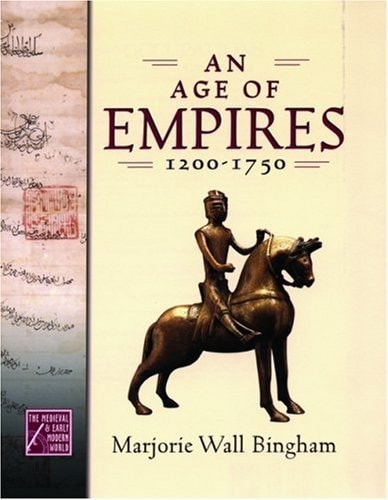
An Age of Empires, 1200-1750
0
0
As an Amazon Associate and affiliate partner, Menrva Books earns from qualifying purchases. Learn more
Author Description
The Age of Empires includes some of the most colorful, ruthless, and restless figures in all of history. During this time Genghis Khan told his troops to "fall upon the enemy like falcons," Ivan the Terrible expelled Mongol invaders from Russia but murdered his own son in a fit of rage, and Babur the Tiger ruled India, combining ferocity on the battlefield with a love of books and poetry. It is a period of extremes: Muslim Turks tolerated Jews and Christians within the Ottoman Empire yet under the Habsburgs the devastating Thirty Years' War pitted Catholics against Protestants. Lithuanian society was remarkably open, granting women the right to own property and decide their religious beliefs while Spanish and Portuguese colonizers enslaved Native Americans and Africans in Peru and Angola. Beautifully illustrated and filled with maps and primary sources, The Age of Empires captures both the historical sweep and vivid details of this transformative period. From Marco Polo's eyewitness account of an opulent Chinese banquet to a missionary's sermon denouncing Spanish atrocities in the Caribbean, these documents bring the era dramatically to life. They show how the spread of empires meant new lands and great wealth for the conquerors, and death, destruction, and slavery for the conquered. But The Age of Empires also shows how, in their relentless outward expansions, imperial rulers brought vastly different peoples into contact, opening new trade routes and stimulating intellectual development, as cultures exchanged both goods and ideas. In these ways as well as others, the Age of Empires is the beginning of our own age. The Medieval and Early Modern World tells the colorful story of a pivotal period in human history, an era that is crucial to understanding our own times. The expansion of trade and city life, the spread and reform of religious institutions, the rise of regional empires and local feudal regimes, and revolutionary advances in science and technology laid the
Menrva's Summary
THE THESIS
How did the expansion of global empires between 1200 and 1750 fundamentally reshape human society, trade, and cultural exchange? Marjorie Wall Bingham examines this transformative era by analyzing the rise of regional powers, the impact of colonial expansion, and the resulting synthesis of goods and ideas. The text utilizes a combination of historical narrative and primary source documentation to illustrate the dual nature of imperial growth as both a catalyst for intellectual development and a source of widespread human suffering.
THE SCOPE MAP
What You Will Find
- Historical analysis of major empires including the Ottoman, Habsburg, and various regional powers in Asia and the Americas.
- Examination of the social and economic consequences of imperial expansion, including trade routes and slavery.
- Integration of primary source documents such as eyewitness accounts, sermons, and historical records.
- Exploration of cultural and religious shifts, including the Thirty Years' War and the status of women in Lithuanian society.
THE AUTHORITY PERSPECTIVE
Educators and historians frequently cite this work as a highly accessible entry point for students exploring the complexities of the medieval and early modern periods. The inclusion of diverse primary source materials is widely praised for providing a balanced view of the era's significant human costs and technological advancements.
Page Count:
0
Publication Date:
2005-01-01
Publisher:
Oxford Univ Pr
ISBN-10:
0195222687
ISBN-13:
9780195222685
History
Middle Ages
Imperialism
World history
Community Tags
Other Editions(2)
Similar Books

Reader Comments
Share Your Thoughts
No comments yet. Be the first to share your thoughts!