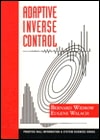
Adaptive Inverse Control
0
0
As an Amazon Associate and affiliate partner, Menrva Books earns from qualifying purchases. Learn more
Author Description
Adaptive inverse control is a novel approach to the design of control systems and regulators. This book takes a "signal processing approach" to adaptive control as used in a natural way to provide model-reference control for a wide variety of plant types. Details examples of how adaptive inverse control can be use to control plants that are unstable as well as stable, nonminimum-phase as well as minimum-phase, nonlinear as well as linear, multiple-input multiple-output (MIMO) as well as single-input single-output (SISO). For control engineers and signal processing engineers.
Menrva's Summary
THE THESIS
This text investigates the application of adaptive inverse control as a signal processing methodology for designing robust control systems and regulators. Authors Bernard Widrow and Eugene Walach, both established experts in signal processing, utilize their extensive research to present a framework that bridges the gap between adaptive signal processing and traditional control theory. The book argues that this approach provides a flexible, model-reference solution capable of managing diverse plant types, ranging from stable linear systems to complex, unstable, nonlinear, and multiple-input multiple-output configurations.
THE SCOPE MAP
What You Will Find
- Theoretical foundations of adaptive inverse control systems
- Practical applications including the Stanford Linear Accelerator beam control
- Simulations for noise control and plant stabilization
- Mathematical derivations for SISO and MIMO systems
Scope Limits
- Requires foundational knowledge of statistics and linear algebra
- Does not provide an introductory overview for readers without engineering backgrounds
THE AUTHORITY PERSPECTIVE
Experts and practitioners identify this work as a foundational text for those specializing in the intersection of adaptive control and signal processing. Readers frequently note the technical density of the prose, which necessitates a strong background in mathematics to fully grasp the presented methodologies.
Page Count:
528
Publication Date:
1995-01-01
Publisher:
Prentice Hall
ISBN-10:
0130059684
ISBN-13:
9780130059680
Manufacturing Systems
Robotics
New Used & Rental Textbooks
Computer Science
Machine Learning
Mechanical
System Design
Engineering
Applied Physics
Mathematics
Control systems
Hardware & DIY
Community Tags
Similar Books