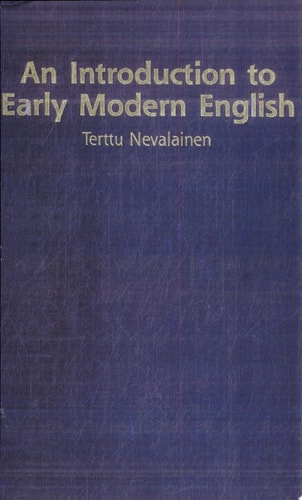
An Introduction to Early Modern English
0
0
As an Amazon Associate and affiliate partner, Menrva Books earns from qualifying purchases. Learn more
Author Description
An Introduction to Early Modern English, helps students of English and linguistics to place the language of the period 1500-1700 in its historical context as a language with a common core but also one which varies across time, regionally and socially, and according to register. The volume focuses on the structure of what contemporaries called the General Dialect--its spelling, vocabulary, grammar and punctuation--and on its dialectal origins. The book also discusses the language situation and linguistic anxieties in England at a time when Latin exerted a strong influence on the rising standard language.
Menrva's Summary
THE THESIS
This text investigates the structural evolution and sociolinguistic landscape of the English language during the Early Modern period between 1500 and 1700. Terttu Nevalainen, a prominent scholar in historical linguistics, utilizes a comprehensive framework to analyze how the language functioned as a cohesive system while simultaneously undergoing significant variation. By examining the interplay between the emerging standard language and regional dialects, the author provides a rigorous account of the linguistic pressures and external influences, such as Latin, that shaped English during this transformative era.
THE SCOPE MAP
What You Will Find
- Analysis of the General Dialect including spelling, vocabulary, grammar, and punctuation conventions.
- Examination of regional and social variation within the English language during the 16th and 17th centuries.
- Discussion of the influence of Latin on the development of the standard English language.
- Exploration of contemporary linguistic anxieties and the sociolinguistic situation in England.
THE AUTHORITY PERSPECTIVE
Experts and students of linguistics frequently cite this work as a foundational text for understanding the complexities of Early Modern English. Readers often note the academic density of the prose, which serves as a reliable resource for those seeking a structured historical overview of the period's language evolution.
Page Count:
186
Publication Date:
2006-03-16
Publisher:
Oxford University Press
ISBN-10:
0195308468
ISBN-13:
9780195308464
History
Reference
Linguistics
Academic
Community Tags
Other Editions(2)

Similar Books