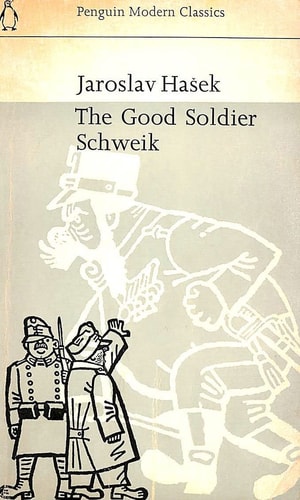
The Good Soldier Švejk
0
0
As an Amazon Associate and affiliate partner, Menrva Books earns from qualifying purchases. Learn more
Author Description
In The Good Soldier Švejk, celebrated Czech writer and anarchist Jaroslav Hašek combined dazzling wordplay and piercing satire in a hilariously subversive depiction of the futility of war.Good-natured and garrulous, Švejk becomes the Austrian army's most loyal Czech soldier when he is called up on the outbreak of World War I -- although his bumbling attempts to get to the front serve only to prevent him from reaching it. Playing cards and getting drunk, he uses all his cunning and genial subterfuge to deal with the police, clergy, and officers who chivy him toward battle.Cecil Parrott's vibrant translation conveys the brilliant irreverence of this classic about a hapless Everyman caught in a vast bureaucratic machine.
Menrva's Summary
THE PULSE
The outbreak of World War I forces the garrulous and ostensibly simple-minded Josef Švejk into the ranks of the Austrian army, where his persistent, bumbling efforts to serve create a chaotic obstacle to the military machine. Švejk navigates the absurdity of the Austro-Hungarian bureaucracy with a mixture of feigned idiocy and genuine geniality. His objective is to survive the conflict while maintaining his own pace, often frustrating the officers and authorities who attempt to force him into the front lines. The narrative utilizes a picaresque framework, following Švejk through a series of episodic encounters that expose the incompetence and corruption of the wartime state.
INSIDE THE PAGES
- Episodic narrative structure following the protagonist's misadventures
- Sharp satirical critique of military bureaucracy and institutional authority
- Use of irony to highlight the futility of war
- Extensive dialogue-driven scenes showcasing Švejk's circular logic
- Vivid depictions of the social and political landscape of the Austro-Hungarian Empire
- Dark humor centered on the incompetence of the ruling class
- Character archetypes representing various levels of state and religious power
- Linguistic playfulness that emphasizes the absurdity of official orders
THE COLLECTIVE ECHO
Readers and critics frequently highlight the work as a definitive example of anti-war satire that remains relevant for its portrayal of individual resistance against systemic madness. Discussion often centers on whether Švejk is a genuine fool or a master of subversive manipulation who uses stupidity as a weapon. The pacing is noted for its meandering, episodic nature, which mirrors the chaotic and often nonsensical progression of the war itself. Many appreciate the balance between the comedic tone and the underlying grim reality of the conflict. The text is widely regarded as a foundational piece of Czech literature that effectively dismantles the dignity of military institutions through relentless mockery.
Page Count:
478
Publication Date:
1969-01-01
Publisher:
Penguin Book, 1969, Great Britain.
ISBN-10:
0140008020
ISBN-13:
9780140008029
Humor
Satire
classic
Literary
Czech
War
Picaresque
Community Tags
Similar Books