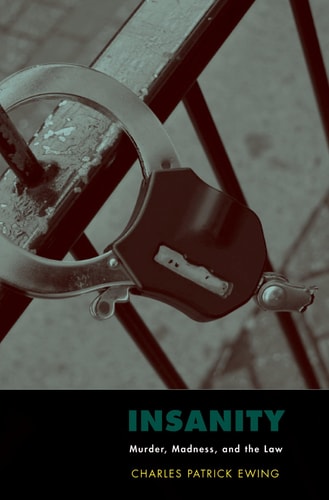
Insanity: Murder, Madness, and the Law
0
0
As an Amazon Associate and affiliate partner, Menrva Books earns from qualifying purchases. Learn more
Author Description
The insanity defense is one of the oldest fixtures of the Anglo-American legal tradition. Though it is available to people charged with virtually any crime, and is often employed without controversy, homicide defendants who raise the insanity defense are often viewed by the public and even the legal system as trying to get away with murder. Often it seems that legal result of an insanity defense is unpredictable, and is determined not by the defendants mental state, but by their lawyers and psychologists influence.From the thousands of murder cases in which defendants have claimed insanity, Doctor Ewing has chosen ten of the most influential and widely varied. Some were successful in their insanity plea, while others were rejected. Some of the defendants remain household names years after the fact, like Jack Ruby, while others were never nationally publicized. Regardless of the circumstances, each case considered here was extremely controversial, hotly contested, and relied heavily on lengthy testimony by expert psychologists and psychiatrists. Several of them played a major role in shaping the criminal justice system as we know it today.In this book, Ewing skillfully conveys the psychological and legal drama of each case, while providing important and fresh professional insights. For the legal or psychological professional, as well as the interested reader, Insanity will take you into the minds of some of the most incomprehensible murderers of our age.
Menrva's Summary
THE THESIS
This book investigates the complex intersection of criminal law and mental health by examining how the insanity defense functions within the American judicial system. Author Charles P. Ewing, a forensic psychologist and legal scholar, utilizes his professional expertise to analyze ten high-profile homicide cases. He argues that the application of the insanity plea is often inconsistent, frequently influenced more by the strategic maneuvers of legal teams and expert witnesses than by the objective mental state of the defendant.
THE SCOPE MAP
What You Will Find
- Analysis of ten diverse and controversial homicide cases involving the insanity defense.
- Examination of the role of expert psychological and psychiatric testimony in court proceedings.
- Historical context of the insanity defense within the Anglo-American legal tradition.
- Evaluation of how specific legal outcomes have shaped modern criminal justice standards.
THE AUTHORITY PERSPECTIVE
Experts and legal professionals frequently cite this work for its balanced approach to the tension between clinical psychology and courtroom procedure. Readers often note the accessibility of the prose, which manages to explain dense legal and psychiatric concepts without sacrificing technical accuracy.
Page Count:
224
Publication Date:
2008-04-07
Publisher:
Oxford University Press
ISBN-10:
019532613X
ISBN-13:
9780195326130
True Crime
Psychology
Non-Fiction
Law
Mentally ill
Forensic Psychology
Community Tags
Similar Books