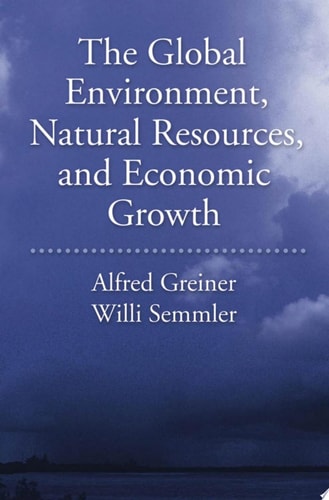
The Global Environment, Natural Resources, and Economic Growth
0
0
As an Amazon Associate and affiliate partner, Menrva Books earns from qualifying purchases. Learn more
Author Description
Recently, the public attention has turned toward the intricate interrelation between economic growth and global warming. This book focuses on this nexus but broadens the framework to study the issue. Growth is seen as global growth, which affects the global environment and climate change. Global growth, in particular high economic growth rates, imply a fast depletion of renewable and non-renewable resources.Thus this book deals with the impact of the environment and the effect of the exhaustive use of natural resources on economic growth and welfare of market economies as well as the reverse linkage. It is arranged in three parts: Part I of the book discusses the environment and growth. There, Greiner and Semmler incorporate the role of environmental pollution into modern endogenous growth models and use recently developed dynamic methods and techniques to derive appropriate abatement activities that policymakers can institute. Part II looks at global climate change using these same growth models. Here, too, the authors provide direct and transparent policy implications. More specifically, the authors favour tax measures, such as a carbon tax, over emission trading as instruments of mitigation policies. Part III evaluates the use and overuse of renewable and non-renewable resources in the context of a variety of dynamic models. They, in particular, consider the cases when resources interact as an ecological system and analyze issues of ownership of resources as well as policy measures to avoid the overuse of resources. In addition, not only intertemporal resource allocation but also the eminent issues relating to intertemporal inequities, as well as policy measures to overcome them, are discussed in each part of the book.
Menrva's Summary
THE THESIS
This book investigates the complex, bidirectional relationship between global economic growth, environmental degradation, and the depletion of natural resources. Alfred Greiner and Will Semmler, both established scholars in dynamic economics, utilize modern endogenous growth models to analyze how market economies can balance welfare with ecological constraints. By applying advanced mathematical techniques, the authors provide a rigorous framework for understanding how policy interventions, such as carbon taxation, can mitigate the negative externalities of industrial expansion.
THE SCOPE MAP
What You Will Find
- Endogenous growth models incorporating environmental pollution and abatement activities.
- Comparative analysis of policy instruments, specifically carbon taxes versus emission trading systems.
- Dynamic modeling of renewable and non-renewable resource depletion within ecological systems.
- Theoretical frameworks addressing intertemporal resource allocation and social equity.
THE AUTHORITY PERSPECTIVE
Experts recognize this work as a sophisticated application of dynamic economic theory to contemporary environmental challenges. Readers frequently note the academic density of the prose, which is tailored for researchers and policymakers familiar with advanced mathematical modeling.
Page Count:
220
Publication Date:
2008-07-25
Publisher:
Oxford University Press
ISBN-10:
019532823X
ISBN-13:
9780195328233
Economics
Public Policy
Natural Resources
Climate Change
Pollution
Community Tags
Similar Books