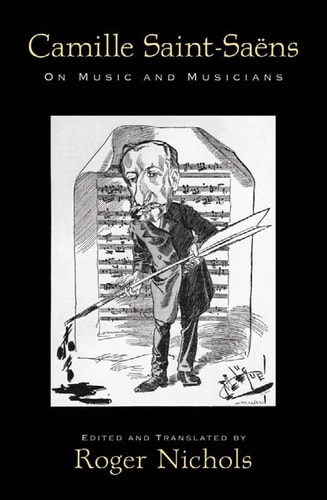
Camille Saint-Saëns: On Music and Musicians
0
0
As an Amazon Associate and affiliate partner, Menrva Books earns from qualifying purchases. Learn more
Author Description
Camille Saint-Saëns is a memorable figure not only for his successes as a composer of choral and orchestral works, and the eternally popular opera Samson et Dalila, but also because he was a keen observer of the musical culture in which he lived. A composer of vast intelligence and erudition, Saint-Saëns was at the same time one of the foremost writers on music in his day. From Wagner, Liszt and Debussy to Milhaud and Stravinsky, Saint-Saëns was at the center of the elite musical and cultural fin de siècle and early 20th Century world. He championed Schumann and Wagner in France at a period when these composers were regarded as dangerous subversives whose music should be kept well away from the impressionable student. Yet Saint-Saëns himself had no aspirations to being a revolutionary, and his appreciation of Wagner the composer was tempered by his reservations over Wagner the philosopher and dramatist, suspicious as he was of what he called "the Germanic preoccupation with going beyond reality." Whether defending Meyerbeer against charges of facility or Berlioz against those who questioned his harmonic grasp, Saint-Saëns was always his own man: in both cases, he claimed, it was "not the absence of faults but the presence of virtues" that distinguishes the good composer.Saint-Saëns's writings provide a well-argued counter-discourse to the strong modernist music critics who rallied around Debussy and Ravel during the fin de siècle. And above all, they demonstrate a brilliantly sharp and active brain, expressing itself through prose of a Classical purity and balance, enlivened throughout with flashes of wit and, at times, of sheer malice.In this generously annotated volume, renowned scholar, seasoned translator and radio broadcaster Roger Nichols brings some of the composer's most striking and evocative writings brilliantly to life in English translation, many for the first time. Nichols has carefully chosen these selections for their intrinsic interest as historical
Menrva's Summary
THE THESIS
This volume investigates the intellectual contributions of Camille Saint-Saëns as a critic and observer of the shifting musical landscape during the fin de siècle and early 20th century. Roger Nichols, a distinguished scholar and translator, compiles and annotates a selection of Saint-Saëns's own writings to illustrate his role as a central figure in French musical culture. The work argues that Saint-Saëns maintained a distinct, classical perspective that challenged the rising modernist movements led by contemporaries like Debussy and Ravel. By presenting these texts in English, Nichols provides a framework for understanding the composer's complex relationship with figures such as Wagner, Liszt, and Berlioz.
THE SCOPE MAP
What You Will Find
- A curated collection of essays and critical writings by Camille Saint-Saëns translated into English.
- Historical context regarding the French musical scene from the late 19th to early 20th century.
- Detailed annotations by Roger Nichols explaining the cultural and personal significance of the composer's arguments.
- Primary source insights into the composer's views on Wagner, Meyerbeer, Berlioz, and the evolution of musical modernism.
THE AUTHORITY PERSPECTIVE
Experts recognize this volume as a vital resource for understanding the intellectual life of a major composer who is often overshadowed by his own creative output. Readers frequently note the clarity of the translations and the depth of the historical context provided by Nichols, making it an accessible entry point for those interested in musicology and French cultural history.
Page Count:
208
Publication Date:
2008-10-27
Publisher:
Oxford University Press
ISBN-10:
0195320166
ISBN-13:
9780195320169
Music
Biography
Non-Fiction
Kindle Store
Music History
Categories
Performance theory
Kindle eBooks
Essays
Composers
Community Tags
Similar Books