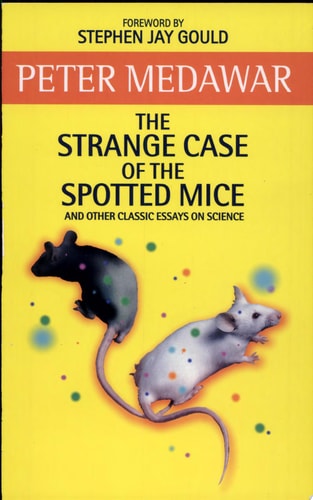
The Strange Case of the Spotted Mice: And Other Classic Essays on Science
0
0
As an Amazon Associate and affiliate partner, Menrva Books earns from qualifying purchases. Learn more
Author Description
Sir Peter Medawar was not only a Nobel prize-winning immunologist but also a wonderful writer about science and scientists. Described by the Washington Post as a "genuinely brilliant popularizer" of science, his essays are remarkable for their clarity and wit. This entertaining selection presents the very best of his writing with a new Foreword by Stephen Jay Gould, one of his greatest admirers. The wide range of subjects include Howard Florey and penicillin, J. B.S. Haldane, whom he describes as a "with-knobs-on variant of us all," and, in the title essay, scientific fraud involving laboratory mice. There is Medawar's defence of James Watson against the storm of criticism that greeted the publication of The Double Helix. A merciless debunker of myths, he reveals the nonsense to be discovered in psychoanalytic interpretations of Darwin's illness and launches devastating attacks on Arthur Koestler, I.Q. psychologists, and, most notably, Teilhard de Chardin. He raises questions about the nature of scientific endeavour-he famously defined science as the art of the soluble-and a common theme is his desire to communicate the importance of science to the widest possible audience.
Menrva's Summary
THE THESIS
This collection investigates the nature of scientific inquiry and the public perception of scientific practice. Sir Peter Medawar, a Nobel laureate in immunology, utilizes his extensive background in biological research to critique the methodologies and cultural myths surrounding science. Through a series of essays, he argues for the necessity of clarity, rigor, and intellectual honesty in both laboratory work and the communication of scientific findings to the general public.
THE SCOPE MAP
What You Will Find
- Historical analysis of scientific figures such as Howard Florey and J.B.S. Haldane
- Critical examinations of scientific fraud and the ethics of research
- Philosophical inquiries into the definition of science as the art of the soluble
- Polemical responses to psychoanalytic interpretations and I.Q. psychology
Scope Limits
- The text does not provide a comprehensive history of immunology
- It does not offer a technical manual for laboratory procedures
THE AUTHORITY PERSPECTIVE
Critics and scientists frequently cite this collection as a model for accessible, high-level scientific prose. Experts highlight Medawar's ability to maintain intellectual rigor while engaging a broad audience, making this a foundational text for those interested in the philosophy and culture of science.
Page Count:
256
Publication Date:
1996-06-13
Publisher:
Oxford University Press
ISBN-10:
019286193X
ISBN-13:
9780192861931
Science
Non-Fiction
Biography
Essays
Science
Philosophy history
Philosophy of
Kindle Store
Categories
Kindle eBooks
Community Tags
Similar Books