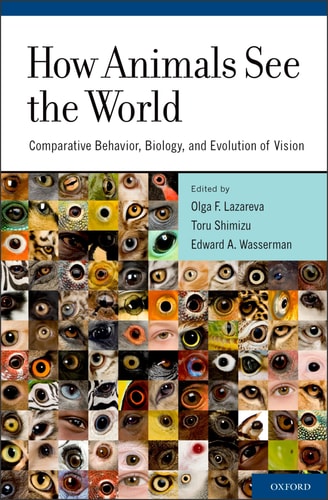
How Animals See the World: Comparative Behavior, Biology, and Evolution of Vision
0
0
As an Amazon Associate and affiliate partner, Menrva Books earns from qualifying purchases. Learn more
Author Description
The visual world of animals is highly diverse and often very different from the world that we humans take for granted. This book provides an extensive review of the latest behavioral and neurobiological research on animal vision, highlighting fascinating species similarities and differences in visual processing. It contains 26 chapters written by world-leading experts about a variety of species including: honeybees, spiders, fish, birds, and primates. The chapters are divided into six sections: Perceptual grouping and segmentation, Object perception and object recognition, Motion perception, Visual attention, Different dimensions of visual perception, and Evolution of the visual system. An exhaustive work in range and depth, How Animals See the World will be a valuable resource for advanced students and researchers in areas of cognitive psychology, perception and cognitive neuroscience, as well as researchers in the visual sciences.
Menrva's Summary
THE THESIS
This book investigates the diverse mechanisms of visual perception across the animal kingdom to determine how biological evolution shapes the way different species interpret their environments. The authors, Edward A. Wasserman, Olga F. Lazareva, and Toru Shimizu, compile contributions from leading experts to synthesize current behavioral and neurobiological data. By examining a wide array of species, the text establishes a comparative framework for understanding the complexities of visual processing and recognition.
THE SCOPE MAP
What You Will Find
- Comparative analysis of visual systems in honeybees, spiders, fish, birds, and primates.
- Examination of perceptual grouping, object recognition, and motion perception.
- Discussion of visual attention and the evolutionary development of sensory systems.
- Synthesis of behavioral and neurobiological research methodologies.
THE AUTHORITY PERSPECTIVE
Experts recognize this volume as a comprehensive reference for advanced students and researchers in cognitive psychology and neuroscience. Readers frequently note the academic density of the prose and the breadth of the multi-disciplinary research presented.
Page Count:
560
Publication Date:
2012-03-14
Publisher:
Oxford University Press
ISBN-10:
0195334655
ISBN-13:
9780195334654
Science
Psychology
Biology
Vision
Zoology
Evolution
Eye
Evolutionary Biology
Physiology Comparative
Neuroscience
Community Tags
Similar Books