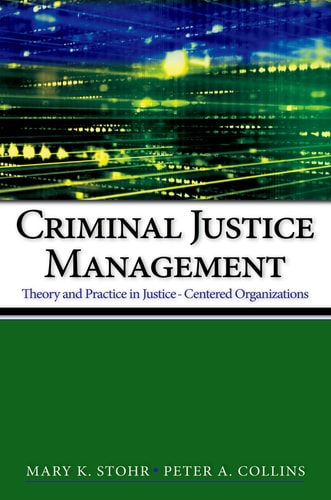
Criminal Justice Management: Theory and Practice in Justice-Centered Organizations
0
0
As an Amazon Associate and affiliate partner, Menrva Books earns from qualifying purchases. Learn more
Author Description
Criminal justice students and practitioners in criminal justice agencies know firsthand the value of effective management; they understand the vital need to develop organizations that meet the expectations of their community members as well as those of their workers. With an innovative, student-friendly approach, Criminal Justice Management: Theory and Practice in Justice-Centered Organizations examines the complex subject of justice-centered agencies.Authors Mary K. Stohr and Peter A. Collins interweave their comprehensive research with humor and personal anecdotes to make the study of criminal justice management accessible--and interesting--to students. Chapter exercises and study questions provide a springboard for lively class discussion, encouraging students to discover relevant applications for these provocative topics. Through its dedicated pedagogy, this text challenges readers to:* Initiate human relations management practices* Provide support for the professional development of staff* Use proactive, collaborative, and shared responsibility forms of leadership* Develop and maintain strong ethical practices* Implement evidence-based best practices in agency programming* Build strong bridges within an engaged and informed communityWith an emphasis on putting theory into practice, Criminal Justice Management is an invaluable resource for the development of efficient, dynamic, and resourceful justice-centered agencies.
Menrva's Summary
THE THESIS
This text investigates how criminal justice agencies can balance organizational efficiency with the ethical demands of community-centered service. Authors Mary K. Stohr and Peter A. Collins utilize their extensive academic backgrounds to bridge the gap between abstract management theory and the daily operational realities of justice organizations. By integrating research with practical application, the authors provide a framework for developing leadership strategies that prioritize human relations, staff development, and evidence-based programming. The book serves as a pedagogical tool designed to prepare students and practitioners for the complexities of modern justice administration.
THE SCOPE MAP
What You Will Find
- Theoretical frameworks for human relations management within justice agencies
- Methodologies for implementing proactive and collaborative leadership models
- Case studies and chapter exercises designed to bridge theory and practice
- Strategies for fostering ethical standards and community engagement
THE AUTHORITY PERSPECTIVE
Experts and educators frequently cite this text as a primary resource for bridging the gap between administrative theory and the practical requirements of justice-centered organizations. Readers often note that the inclusion of pedagogical tools and personal anecdotes makes the dense subject matter accessible for both students and working professionals.
Page Count:
352
Publication Date:
2008-03-19
Publisher:
Oxford University Press
ISBN-10:
0195337611
ISBN-13:
9780195337617
Administration of Justice
Court Administration
Sociology
Management
Leadership
Public Administration
Police Administration