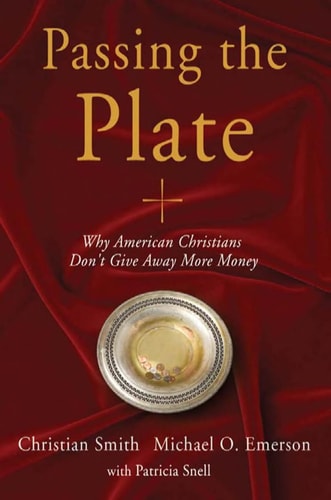
Passing the Plate: Why American Christians Don't Give Away More Money
0
0
As an Amazon Associate and affiliate partner, Menrva Books earns from qualifying purchases. Learn more
Author Description
Passing the Plate shows that few American Christians donate generously to religious and charitable causes -- a parsimony that seriously undermines the work of churches and ministries. Far from the 10 percent of one's income that tithing requires, American Christians' financial giving typically amounts, by some measures, to less than one percent of annual earnings. And a startling one out of five self-identified Christians gives nothing at all.This eye-opening book explores the reasons behind such ungenerous giving, the potential world-changing benefits of greater financial giving, and what can be done to improve matters. If American Christians gave more generously, say the authors, any number of worthy projects -- from the prevention and treatment of HIV/AIDS to the promotion of inter-religious understanding to the upgrading of world missions -- could be funded at astounding levels. Analyzing a wide range of social surveys and government and denominational statistical datasets and drawing on in-depth interviews with Christian pastors and church members in seven different states, the book identifies a crucial set of factors that appear to depress religious financial support -- among them the powerful allure of a mass-consumerist culture and its impact on Americans' priorities, parishioners' suspicions of waste and abuse by nonprofit administrators, clergy's hesitations to boldly ask for money, and the lack of structure and routine in the way most American Christians give away money. In their conclusion, the authors suggest practical steps that clergy and lay leaders might take to counteract these tendencies and better educate their congregations about the transformative effects of generous giving.By illuminating the social and psychological forces that shape charitable giving, Passing the Plate is sure to spark a much-needed debate on a critical issue that is of much interest to church-goers, religious leaders, philanthropists, and social scientists.
Menrva's Summary
THE THESIS
This book investigates the disparity between the biblical ideal of tithing and the actual financial giving habits of American Christians. The authors, Michael O. Emerson, Patricia Snell, and Christian Smith, utilize a rigorous sociological framework to examine why self-identified Christians contribute a small fraction of their annual income to religious and charitable causes. By synthesizing statistical data with qualitative interviews, they argue that consumerist culture, institutional distrust, and a lack of systematic giving structures significantly suppress charitable contributions.
THE SCOPE MAP
What You Will Find
- Analysis of national social surveys and government statistical datasets regarding religious giving.
- Qualitative insights derived from in-depth interviews with pastors and lay members across seven states.
- Examination of the psychological and social pressures exerted by mass-consumerist culture on personal financial priorities.
- Practical recommendations for clergy and church leadership to foster a culture of generosity within congregations.
THE AUTHORITY PERSPECTIVE
Sociologists and religious leaders frequently cite this work as a foundational text for understanding the intersection of American consumerism and religious practice. Experts highlight the book's empirical rigor and its utility for church administrators seeking to address systemic barriers to congregational financial support.
Page Count:
288
Publication Date:
2008-09-29
Publisher:
Oxford University Press
ISBN-10:
0195337115
ISBN-13:
9780195337112
Religion
Economics
Christianity
Philanthropy
Sociology
Christians
Social Science
Community Tags
Similar Books



Reader Comments
Share Your Thoughts
No comments yet. Be the first to share your thoughts!