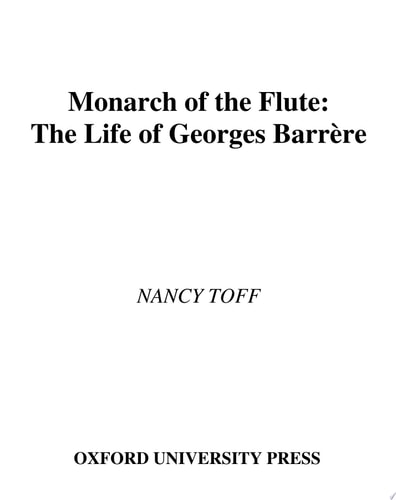
Monarch of the Flute: The Life of Georges Barrère
0
0
As an Amazon Associate and affiliate partner, Menrva Books earns from qualifying purchases. Learn more
Author Description
Georges Barrère (1876-1944) holds a preeminent place in the history of American flute playing. Best known for two of the landmark works that were written for him--the Poem of Charles Tomlinson Griffes and Density 21.5 by Edgard Varèse--he was the most prominent early exemplar of the Paris Conservatoire tradition in the United States and set a new standard for American woodwind performance. Barrère's story is a musical tale of two cities, and this book uses his life as a window onto musical life in Belle Epoque Paris and twentieth-century New York. Recurrent themes are the interactions of composers and performers; the promotion of new music; the management, personnel, and repertoire of symphony orchestras; the economic and social status of the orchestral and solo musician, including the increasing power of musicians' unions; the role of patronage, particularly women patrons; and the growth of chamber music as a professional performance medium. A student of Paul Taffanel at the Paris Conservatoire, by age eighteen Barrère played in the premiere of Debussy's Prelude to the Afternoon of a Faun. He went on to become solo flutist of the Concerts Colonne and to found the Société Moderne d'Instruments à Vent, a pioneering woodwind ensemble that premiered sixty-one works by forty composers in its first ten years. Invited by Walter Damrosch to become principal flute of the New York Symphony in 1905, he founded the woodwind department at the Institute of Musical Art (later Juilliard). His many ensembles toured the United States, building new audiences for chamber music and promoting French repertoire as well as new American music. Toff narrates Barrère's relationships with the finest musicians and artists of his day, among them Isadora Duncan, Yvette Guilbert, André Caplet, Paul Hindemith, Albert Roussel, Wallingford Riegger, and Henry Brant. The appendices of the book, which list Barrère's 170 premieres and the 50 works dedicated to him, are a resource for a new generation of.
Menrva's Summary
THE THESIS
This biography investigates how Georges Barrère served as the primary conduit for the Paris Conservatoire tradition in the United States, effectively reshaping American woodwind performance standards. Nancy Toff, a respected music historian, utilizes extensive archival research and primary source documentation to trace Barrère's career from his early success in Belle Epoque Paris to his influential tenure in twentieth-century New York. The text argues that Barrère's professional trajectory was not merely a personal success story but a catalyst for the institutionalization of chamber music and the professionalization of orchestral musicians in America.
THE SCOPE MAP
What You Will Find
- Detailed analysis of the Paris Conservatoire woodwind pedagogy and its migration to the United States.
- Historical documentation of the premiere performances of landmark works by Debussy, Griffes, and Varèse.
- Examination of the socio-economic evolution of the professional musician, including the rise of labor unions and the influence of private patronage.
- Comprehensive appendices cataloging 170 premieres and 50 dedicated works, serving as a reference for musicologists and performers.
THE AUTHORITY PERSPECTIVE
Experts and music historians recognize this work as the definitive account of Barrère's life and his impact on woodwind performance. Readers frequently note the meticulous detail and the scholarly rigor with which Toff contextualizes the broader musical landscape of the early twentieth century.
Page Count:
464
Publication Date:
2005-01-01
Publisher:
Oxford University Press, Incorporated
ISBN-10:
0195346920
ISBN-13:
9780195346923
History
Biography
Music
Humanities
Flute players
Woodwinds
Musicians
United States
Flute Music
Music History
Community Tags
Similar Books