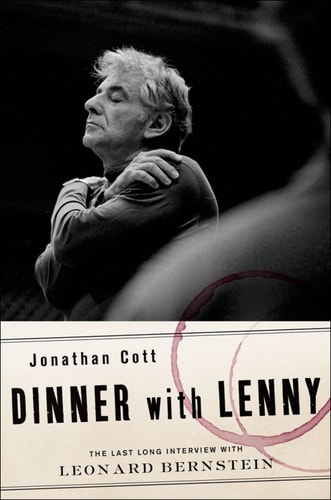
Dinner with Lenny: The Last Long Interview with Leonard Bernstein
0
0
As an Amazon Associate and affiliate partner, Menrva Books earns from qualifying purchases. Learn more
Author Description
Leonard Bernstein was arguably the most highly esteemed, influential, and charismatic American classical music personality of the twentieth century. Conductor, composer, pianist, writer, educator, and human rights activist, Bernstein truly led a life of Byronic intensity--passionate, risk-taking, and convention-breaking.In November 1989, just a year before his death, Bernstein invited writer Jonathan Cott to his country home in Fairfield, Connecticut for what turned out to be his last major interview--an unprecedented and astonishingly frank twelve-hour conversation. Now, in Dinner with Lenny, Cott provides a complete account of this remarkable dialogue in which Bernstein discourses with disarming frankness, humor, and intensity on matters musical, pedagogical, political, psychological, spiritual, and the unabashedly personal. Bernstein comes alive again, with vodka glass in hand, singing, humming, and making pointed comments on a wide array of topics, from popular music ("the Beatles were the best songwriters since Gershwin"), to great composers ("Wagner was always in a psychotic frenzy. He was a madman, a megalomaniac"), and politics (lamenting "the brainlessness, the mindlessness, the carelessness, and the heedlessness of the Reagans of the world"). And of course, Bernstein talks of conducting, advising students "to look at the score and make it come alive as if they were the composer. If you can do that, you're a conductorand if you can't, you're not. If I don't become Brahms or Tchaikovsky or Stravinsky when I'm conducting their works, then it won't be a great performance."After Rolling Stone magazine published an abridged version of the conversation in 1990, the Chicago Tribune praised it as "an extraordinary interview" filled with "passion, wit, and acute analysis." Studs Terkel called the interview "astonishing and revelatory." Now, this full-length version provides the reader with a unique, you-are-there perspective on what it was like to converse with this
Menrva's Summary
THE THESIS
What were the final reflections and intellectual preoccupations of Leonard Bernstein, one of the most influential figures in twentieth-century American classical music? Jonathan Cott, a seasoned journalist, presents a comprehensive transcript of a twelve-hour conversation held at Bernstein's Connecticut home in 1989. The book serves as a primary source document, capturing the conductor's candid views on music theory, pedagogy, global politics, and his own spiritual and psychological development just months before his passing.
THE SCOPE MAP
What You Will Find
- A verbatim account of a twelve-hour, wide-ranging dialogue between Jonathan Cott and Leonard Bernstein.
- Commentary on the evolution of musical composition, including critiques of Wagner, the Beatles, and Gershwin.
- Insights into the methodology of conducting, emphasizing the necessity of internalizing the composer's intent.
- Observations on the political climate of the late 1980s and the intersection of art and social activism.
THE AUTHORITY PERSPECTIVE
Critics and scholars regard this text as a vital primary source for understanding the late-career philosophy of a musical icon. Readers frequently note the intimate, conversational tone of the prose, which provides a rare, unvarnished look at Bernstein's personality and intellectual rigor.
Page Count:
192
Publication Date:
2013-01-01
Publisher:
Oxford University Press
ISBN-10:
0199311471
ISBN-13:
9780199311477
Biography
Music
Non-Fiction
History
Musicians
American History
United States
Music History
Interviews
Humanities
Community Tags
Similar Books