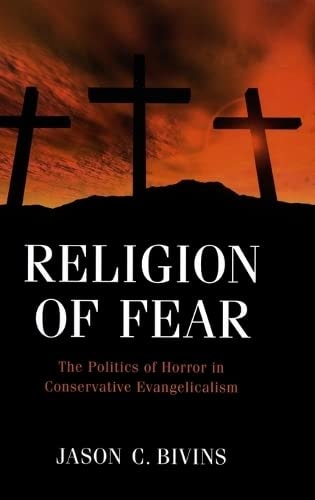
Religion of Fear: The Politics of Horror in Conservative Evangelicalism
0
0
As an Amazon Associate and affiliate partner, Menrva Books earns from qualifying purchases. Learn more
Author Description
Conservative evangelicalism has transformed American politics, disseminating a sometimes fearful message not just through conventional channels, but through subcultures and alternate modes of communication. Within this world is a "Religion of Fear," a critical impulse that dramatizes cultural and political conflicts and issues in frightening ways that serve to contrast "orthodox" behaviors and beliefs with those linked to darkness, fear, and demonology. Jason Bivins offers close examinations of several popular evangelical cultural creations including the Left Behind novels, church-sponsored Halloween "Hell Houses," sensational comic books, especially those disseminated by Jack Chick, and anti-rock and -rap rhetoric and censorship. Bivins depicts these fascinating and often troubling phenomena in vivid (sometimes lurid) detail and shows how they seek to shape evangelical cultural identity.As the "Religion of Fear" has developed since the 1960s, Bivins sees its message moving from a place of relative marginality to one of prominence. What does it say about American public life that such ideas of fearful religion and violent politics have become normalized? Addressing this question, Bivins establishes links and resonances between the cultural politics of evangelical pop, the activism of the New Christian Right, and the political exhaustion facing American democracy.Religion of Fear is a significant contribution to our understanding of the new shapes of political religion in the United States, of American evangelicalism, of the relation of religion and the media, and the link between religious pop culture and politics.
Menrva's Summary
THE THESIS
This book investigates how the "Religion of Fear" within conservative evangelicalism has shaped American political discourse and cultural identity since the 1960s. Jason C. Bivins, a scholar of religious studies, utilizes a multidisciplinary approach to analyze how evangelical subcultures employ fear-based narratives to define orthodox beliefs against perceived demonic threats. By examining the intersection of media, pop culture, and political activism, Bivins argues that these once-marginalized rhetorical strategies have become normalized within the broader American public sphere.
THE SCOPE MAP
What You Will Find
- Analysis of evangelical cultural artifacts including the Left Behind series and Jack Chick comic books.
- Examination of "Hell Houses" and other performative religious spectacles.
- Investigation into the rhetoric of anti-rock and anti-rap censorship campaigns.
- Exploration of the links between religious pop culture and the political agenda of the New Christian Right.
THE AUTHORITY PERSPECTIVE
Scholars and critics frequently cite this work as a foundational text for understanding the intersection of religious media and political polarization in the United States. Readers often note the academic rigor of the prose, which provides a detailed, objective look at phenomena that are often dismissed as mere fringe culture.
Page Count:
336
Publication Date:
2008-08-29
Publisher:
Oxford University Press
ISBN-10:
0195340817
ISBN-13:
9780195340815
Religion
Politics
Horror
American History
Fear
Sociology
Religious Aspects
Evangelicalism
Community Tags
Similar Books