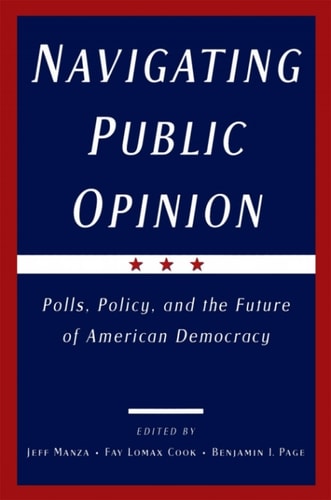
Navigating Public Opinion: Polls, Policy, and the Future of American Democracy
0
0
As an Amazon Associate and affiliate partner, Menrva Books earns from qualifying purchases. Learn more
Author Description
Do politicians listen to the public? How often and when? Or are the views of the public manipulated or used strategically by political and economic elites? Navigating Public Opinion brings together leading scholars of American politics to assess and debate these questions. It describes how the relationship between opinion and policy has changed over time; how key political actors use public opinion to formulate domestic and foreign policy; and how new measurement techniques might improve our understanding of public opinion in contemporary polling and survey research.The distinguished contributors shed new light on several long-standing controversies over policy responsiveness to public opinion. Featuring a new analysis by Robert Erikson, Michael MacKuen, and James Stimson that builds from their pathbreaking work on how public mood moves policy in a macro-model of policymaking, the volume also includes several critiques of this model by Lawrence Jacobs and Robert Shapiro, another critique by G. William Domhoff, and a rejoinder by Erikson and his coauthors. Other highlights include discussions of how political elites, including state-level policymakers, presidents, and makers of foreign policy, use (or shape) public opinion; and analyses of new methods for measuring public opinion such as survey-based experiments, probabilistic polling methods, non-survey-based measures of public opinion, and the potential and limitations of Internet polls and surveys. Introductory and concluding essays provide useful background context and offer an authoritative summary of what is known about how public opinion influences public policy.A must-have for all students of American politics, public opinion, and polling, this state-of-the-art collection addresses issues that lie at the heart of democratic governance today.
Menrva's Summary
THE THESIS
This volume investigates the complex, often contentious relationship between public opinion and the formation of government policy within the American democratic framework. The authors, including Benjamin I. Page, Fay Lomax Cook, and Jeff Manza, curate a collection of scholarly essays that examine whether political and economic elites truly respond to the public or if they manipulate public sentiment for strategic gain. By synthesizing historical data, macro-models of policymaking, and contemporary survey methodologies, the contributors provide a rigorous evaluation of democratic responsiveness in the United States.
THE SCOPE MAP
What You Will Find
- Longitudinal analysis of how the relationship between public opinion and policy has evolved over time.
- Comparative critiques of macro-models regarding how public mood influences domestic and foreign policy.
- Methodological evaluations of polling techniques, including survey-based experiments, probabilistic methods, and Internet-based data collection.
- Case studies on how political actors, from state-level officials to presidents, utilize and shape public opinion to achieve policy objectives.
THE AUTHORITY PERSPECTIVE
Experts recognize this collection as a foundational text for understanding the mechanics of American political responsiveness and the limitations of current polling data. Readers frequently note the academic density of the prose, which serves as a comprehensive resource for students and researchers in political science.
Page Count:
394
Publication Date:
2002-01-01
Publisher:
Oxford University Press, USA
ISBN-10:
0195348842
ISBN-13:
9780195348842
Sociology
Public Policy
American Politics
Research Methods
Democracy
Community Tags
Other Editions(2)
Similar Books

Reader Comments
Share Your Thoughts
No comments yet. Be the first to share your thoughts!