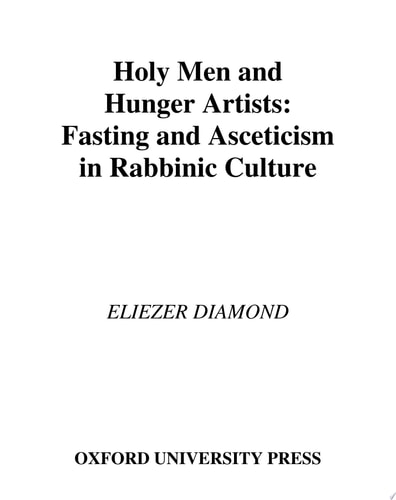
Holy Men and Hunger Artists: Fasting and Asceticism in Rabbinic Culture
0
0
As an Amazon Associate and affiliate partner, Menrva Books earns from qualifying purchases. Learn more
Author Description
The existence of ascetic elements within rabbinic Judaism has generally been either overlooked or actually denied. This is in part because asceticism is commonly identified with celibacy, whereas the rabbis emphasized sexuality as a positive good. In addition, argues Eliezer Diamond, it serves the theological agendas of both Jewish and Christian scholars to characterize Judaism as non- or anti-ascetic. In fact, however, Diamond shows that rabbinic asceticism does indeed exist. This asceticism is mainly secondary, rather than primary, in that the rabbis place no value on self-denial in and of itself, but rather require of themselves the virtual abandonment of familial, social, and economic life in favor of an absolute commitment to the study of the Torah. It is an asceticism of neglect, rather than negation. He also notes that this asceticism of neglect dovetails with the rabbinic theology of sin and punishment, which encourages delaying gratification in this world in the hopes of a greater reward in the next. The rabbis believed, moreover, that every pleasure taken in this world detracts from what awaits one in the future. The rabbis valued and occasionally engaged in primary asceticism as well. In fact, as Diamond shows, the vocabulary of holiness was often used by the rabbis in connection with voluntary self-denial. One form of primary asceticism--fasting--became increasingly popular in the wake of the destruction of the second temple. He traces this development to the need to mourn the temple's devastation but also to the cessation of three forms of temple-related rituals: the sacrificial cult, the Ma'amadot (groups that would fast, pray, and read from the Torah while daily sacrifices were offered), and naziritism. Fasting is linked by the rabbis to each of these practices and Diamond shows that fasting was seen as a substitute for them after the temple was destroyed. In a final chapter, Diamond shows that there is a greater tendency toward asceticism among the P
Menrva's Summary
THE THESIS
This book investigates the presence and theological function of ascetic practices within rabbinic Judaism, challenging the common scholarly assumption that the tradition is inherently non-ascetic. Eliezer Diamond, a scholar of rabbinic literature, utilizes a historical and theological framework to argue that asceticism in this context is primarily an 'asceticism of neglect'—a byproduct of absolute devotion to Torah study—rather than a negation of the physical world. By examining rabbinic texts and historical shifts following the destruction of the Second Temple, Diamond demonstrates how self-denial served as a substitute for lost ritual practices and a mechanism for navigating the theology of sin and reward.
THE SCOPE MAP
What You Will Find
- Analysis of the distinction between primary and secondary asceticism in rabbinic thought.
- Examination of fasting as a ritual substitute for the sacrificial cult, Ma'amadot, and naziritism.
- Discussion of the rabbinic theology of sin, punishment, and the delay of gratification.
- Historical context regarding the impact of the Second Temple's destruction on Jewish religious practice.
THE AUTHORITY PERSPECTIVE
Scholars recognize this work as a significant intervention in the study of rabbinic culture, noting its ability to nuance the understanding of Jewish attitudes toward self-denial. Readers frequently highlight the clarity with which Diamond navigates complex theological arguments and historical transitions.
Page Count:
240
Publication Date:
2003-01-01
Publisher:
Oxford University Press
ISBN-10:
0195350251
ISBN-13:
9780195350258
Religion
History
Asceticism
Criticism history
Judaism
Theology
Community Tags
Similar Books