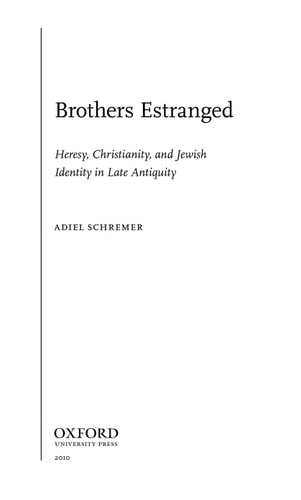
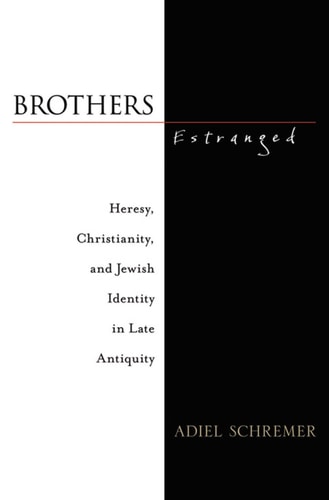
Brothers Estranged: Heresy, Christianity and Jewish Identity in Late Antiquity
0
0
As an Amazon Associate and affiliate partner, Menrva Books earns from qualifying purchases. Learn more
Author Description
The emergence of formative Judaism has traditionally been examined in light of a theological preoccupation with the two competing religious movements, 'Christianity' and 'Judaism' in the first centuries of the Common Era. In this book Ariel Schremer attempts to shift the scholarly consensus away from this paradigm, instead privileging the rabbinic attitude toward Rome, the destroyer of the temple in 70 C.E., over their concern with the nascent Christian movement. The palpable rabbinic political enmity toward Rome, says Schremer, was determinative in the emerging construction of Jewish self-identity. He asserts that the category of heresy took on a new urgency in the wake of the trauma of the Temple's destruction, which demanded the construction of a new self-identity. Relying on the late 20th-century scholarly depiction of the slow and measured growth of Christianity in the empire up until and even after Constantine's conversion, Schremer minimizes the extent to which the rabbis paid attention to the Christian presence. He goes on, however, to pinpoint the parting of the ways between the rabbis and the Christians in the first third of the second century, when Christians were finally assigned to the category of heretics.
Menrva's Summary
THE THESIS
This book investigates whether the formation of Jewish identity in late antiquity was primarily driven by internal theological conflict with Christianity or by external political reactions to the Roman Empire. Adiel Schremer, a scholar of rabbinic literature, challenges the traditional paradigm that emphasizes the 'parting of the ways' between Judaism and Christianity as the central catalyst for Jewish self-definition. By analyzing rabbinic texts alongside historical evidence of the Roman occupation, he argues that the trauma of the Temple's destruction in 70 C.E. and the subsequent political enmity toward Rome were the primary forces shaping the rabbinic construction of identity. The work posits that the categorization of Christians as heretics was a secondary, later development rather than the foundational preoccupation of the era.
THE SCOPE MAP
What You Will Find
- Analysis of rabbinic attitudes toward the Roman Empire following the destruction of the Second Temple.
- Historical examination of the growth and visibility of Christianity within the Roman Empire prior to Constantine.
- A chronological framework identifying the early second century as the period when Christians were formally classified as heretics.
- Critical evaluation of 20th-century scholarly consensus regarding Jewish-Christian relations.
THE AUTHORITY PERSPECTIVE
Scholars recognize this work as a significant intervention in the study of late antique religious history, particularly for its rigorous questioning of the 'parting of the ways' narrative. Readers frequently note the academic density of the prose and the author's meticulous use of rabbinic source material to support his revisionist thesis.
Page Count:
296
Publication Date:
2010-01-20
Publisher:
Oxford University Press
ISBN-10:
019538377X
ISBN-13:
9780195383775
History
Religion
Theology
Judaism
Late Antiquity
Criticism history
Christianity
Community Tags
Other Editions(3)

Similar Books