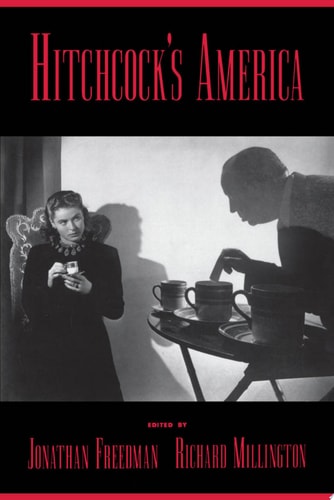
Hitchcock's America
0
0
As an Amazon Associate and affiliate partner, Menrva Books earns from qualifying purchases. Learn more
Author Description
Alfred Hitchcock's American Films Are Not Only Among The Most Admired Works In World Cinema, They Also Offer Some Of Our Most Acute Responses To The Changing Shape Of American Society In The 1940s, 50s, And 60s. The Authors Of This Anthology Show How Famous Films Such As Strangers On A Train, Vertigo, North By Northwest, And Rear Window, Along With More Obscure Ones Such As Rope, The Wrong Man, And Family Plot, Register The Ideologies And Insurgencies, The Normative Assumptions And The Cultural Alternatives, That Shaped These Tumultuous Decades. They Argue That, Just As These Films Occupy A Visual Landscape Defined By The Grand Monuments Of American Civic Life--mt. Rushmore, The Statue Of Liberty, The United Nations--they Are Also Marked By Their Preoccupation With The Social Mores And Private Practices Of Mid-century America. Not Only Are Big-city And Suburban Life The Explicit Subjects Of Films Like Rear Window And Shadow Of A Doubt, So Are The Forms Of Experience That Emerge Within These Social Spaces, Whether The Urban Voyeurism Examined By The Former Or The Intertwining Of Banality And Violence Depicted In The Latter. Indeed, Just About Every Form Of American Life That Was Achieving Social Power At This Time--the National Security State; The Science And Art Of Psychoanalysis; The Privileging Of The Free-wheeling, Improvisatory Self; The Postwar Codification And Fissuring Of Gender Roles; Road-culture And Its Ancillary Creation, The Motel--is Given Detailed, Critical, And Mordant Examination In Hitchcocks Films. The Hitchcock Who Emerges Is Not Merely The Inspired Technician And Psychological Excavator That Critics Of The Past Two Generations Have Justly Hailed; He Is Also A Cultural Critic Of Remarkable Insight And Undeniable Prescience.
Menrva's Summary
THE THESIS
This anthology investigates how Alfred Hitchcock’s American filmography functions as a critical reflection of the shifting social, political, and cultural landscape of the United States between the 1940s and 1960s. Editors Jonathan Freedman and Richard Millington curate a collection of essays that analyze Hitchcock not merely as a technical master of suspense, but as a perceptive cultural critic. By examining the intersection of iconic American monuments and the private anxieties of mid-century life, the contributors argue that these films provide a sophisticated record of the era's evolving ideologies, gender norms, and institutional power structures.
THE SCOPE MAP
What You Will Find
- Analysis of major cinematic works including Vertigo, North by Northwest, and Rear Window.
- Examination of mid-century American phenomena such as the rise of the national security state, the influence of psychoanalysis, and the emergence of road culture.
- Critical exploration of the tension between suburban domesticity and the underlying violence of the era.
- Theoretical frameworks addressing urban voyeurism, gender role codification, and the construction of the improvisatory self.
THE AUTHORITY PERSPECTIVE
Scholars and film critics recognize this collection as a significant contribution to the field of Hitchcock studies, specifically for its shift away from purely formalist analysis toward a sociopolitical lens. Readers frequently note the academic density of the prose, which serves as a foundational text for those interested in the intersection of mid-century American history and classic cinema.
Page Count:
208
Publication Date:
1999-01-01
Publisher:
Oxford University Press
ISBN-10:
0195353315
ISBN-13:
9780195353310
Non-Fiction
United States
Cultural History
American Studies
National characteristics American
Cinema
Film Studies
Community Tags
Similar Books