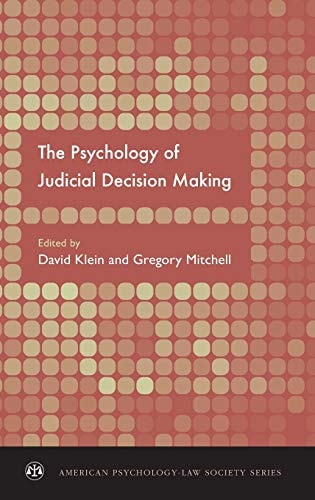
The Psychology of Judicial Decision Making
0
0
As an Amazon Associate and affiliate partner, Menrva Books earns from qualifying purchases. Learn more
Author Description
While scholars in the past several decades have made great progress in explaining what judges do, there remains a certain lack of depth to our understanding. This volume grew from a belief that close examination of the psychological processes underlying judicial decision making can greatly enrich this understanding. The collected essays map ways of incorporating key concepts and findings from psychology into the study of judging.The first section of the book takes as its starting point the fact that judges make many of the same judgments and decisions that ordinary people make and considers how our knowledge about judgment and decision-making in general applies to the case of legal judges. In the second section, chapters focus on the specific tasks that judges perform within a unique social setting and examine the expertise and particular modes of reasoning that judges develop to deal with their tasks in this unique setting. Finally, the third section raises questions about whether and how we can evaluate judicial performance, with implications for the possibility of improving judging through the selection and training of judges and structuring of judicial institutions. Together the essays will foster a better understand how judges make decisions, and open new avenues of inquiry into influences on judicial behavior.
Menrva's Summary
THE THESIS
This volume investigates the psychological mechanisms and cognitive processes that influence judicial decision making to bridge the gap between general human judgment and specific legal outcomes. Editors David E. Klein and Gregory Mitchell compile a series of essays that apply psychological research to the bench, arguing that understanding the internal logic of judges is essential for evaluating and improving judicial performance. The work synthesizes findings from cognitive psychology and legal theory to provide a framework for analyzing how judges process information within the unique constraints of the courtroom.
THE SCOPE MAP
What You Will Find
- Analysis of general judgment and decision-making theories applied to legal contexts.
- Examination of judicial expertise and specialized modes of reasoning.
- Discussion on the evaluation of judicial performance and institutional structure.
- Proposals for improving judicial selection and training based on psychological insights.
THE AUTHORITY PERSPECTIVE
Experts identify this collection as a foundational interdisciplinary text that successfully bridges the divide between behavioral science and legal scholarship. Readers frequently note the academic density of the prose, which serves as a primary resource for students and professionals interested in the intersection of law and psychology.
Page Count:
360
Publication Date:
2010-02-08
Publisher:
Oxford University Press
ISBN-10:
0195367588
ISBN-13:
9780195367584
Psychology
Law
Legal Studies
Sociology
Decision Making
Community Tags
Similar Books