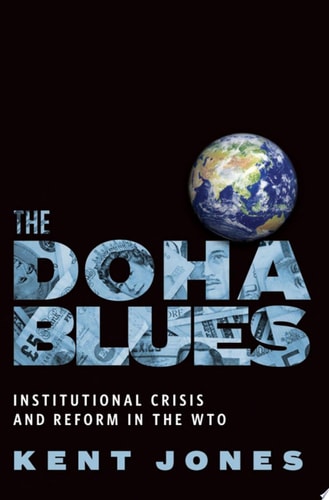
The Doha Blues: Institutional Crisis and Reform in the WTO
0
0
As an Amazon Associate and affiliate partner, Menrva Books earns from qualifying purchases. Learn more
Author Description
The collapse of the Doha Round hangs heavily over an already troubled world economy. Some have concluded that this failure is simply the result of a lack of political will and a pre-occupation with issues such as terrorism. But as Kent Jones reveals in The Doha Blues, the World Trade Organization needs serious structural changes, not just political backbone. He shows for instance that the WTO--now with 153 members--has become increasingly unwieldy in terms of concluding trade agreements and he suggests that countries organize around specific platform positions, a strategy that would make the "holy grail" of consensus once again possible. Jones also argues for financial support for poorer countries so that they can participate effectively in negotiations and he contends that the principle of the "single undertaking" (that "there is no agreement until everything is agreed") has become a serious and perhaps crippling constraint, and must be modified. Jones is a leading authority on trade policy and his book illuminates the real stumbling blocks to trade liberalization and highlights the way around them.
Menrva's Summary
THE THESIS
Does the collapse of the Doha Round signify a terminal failure of political will, or does it reveal an urgent need for structural reform within the World Trade Organization? Kent Jones, a recognized authority on international trade policy, examines the institutional mechanics that have rendered the WTO increasingly ineffective as its membership has expanded. He argues that the current consensus-based model and the rigid 'single undertaking' principle act as systemic barriers to progress, necessitating a shift toward more flexible, platform-based negotiation strategies to restore functional trade liberalization.
THE SCOPE MAP
What You Will Find
- Analysis of the structural inefficiencies inherent in a 153-member consensus-based organization.
- Evaluation of the 'single undertaking' principle and its role as a constraint on multilateral agreements.
- Proposed strategies for organizing member nations around specific platform positions to facilitate negotiation.
- Recommendations for financial and logistical support mechanisms to improve the participation of developing nations.
THE AUTHORITY PERSPECTIVE
Experts identify this work as a critical examination of the institutional limitations facing modern global trade governance. Readers frequently note the clarity with which Jones dissects complex policy constraints, making it a valuable resource for students and practitioners of international economics.
Page Count:
254
Publication Date:
2009-11-05
Publisher:
Oxford University Press
ISBN-10:
0195378822
ISBN-13:
9780195378825
Economics
Trade Policy
Globalization
International relations
Free trade
World Trade Organization
Community Tags
Similar Books