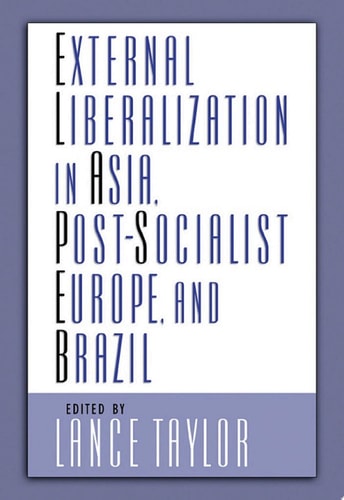
External Liberalization in Asia, Post-Socialist Europe, and Brazil
0
0
As an Amazon Associate and affiliate partner, Menrva Books earns from qualifying purchases. Learn more
Author Description
This book reviews the experience of 14 countries with external liberalization and related policies, based on papers written by national authors following a common macroeconomic methodology. The methodology, the papers' main results, and policy implications are summarized in the introductory chapter.The book reports on a follow-on project to the country studies presented in Lance Taylor (ed.), External Liberalization, Economic Performance, and Social Policy, OUP, 2001. The new project represents a significant extension of the earlier work in that it focuses principally on formerly socialist European economies (Hungary, Poland, Russia), Asian economies (consistently growing China, India, Singapore, and Vietnam; the 1997-98 crisis victims Indonesia, Korea, Malaysia, and Thailand; and cyclically stagnant Philippines and Turkey). Brazil is also included as an important comparator. Macroeconomics has traditionally been less actively pursued in Asia and the transition economies than, say, in Latin America. The 1997-98 crisis awoke the Asians to the importance of macro, and the present book is in part a response to the development.A distinguishing feature of the book is the common methodology, which focuses on the mechanisms via which effective demand is generated and the interactions of labor productivity, employment growth, and income distribution. The country papers show clearly how trade and capital account liberalization along with changes in the real exchange rate affected demand, productivity, and employment at the country level. They also trace through shifts in the overall income distribution and the incidence of poverty. The authors of the papers bring a wealth of insight into their thick descriptions à la Clifford Geertz's famous Balinese cockfight about how diverse economies responded to rather similar reform packages and offer lessons about ongoing institutional change. They also suggest policy shifts that may help make economic performance better in the future
Menrva's Summary
THE THESIS
This book investigates the varied economic outcomes of external liberalization policies across 14 distinct nations in Asia, post-socialist Europe, and Brazil. Lance Taylor, a prominent economist, synthesizes a series of country-specific studies that utilize a unified methodological framework to evaluate the impact of trade and capital account reforms. By focusing on effective demand, labor productivity, and income distribution, the text provides a comparative analysis of how different institutional environments respond to similar reform packages.
THE SCOPE MAP
What You Will Find
- Comparative analysis of 14 countries including China, India, Russia, Poland, and Brazil.
- A unified macroeconomic methodology focusing on effective demand and employment growth.
- Examination of the 1997-98 Asian financial crisis and its influence on regional macroeconomic policy.
- Assessment of how trade liberalization affects income distribution and poverty incidence.
THE AUTHORITY PERSPECTIVE
Experts recognize this work as a significant contribution to comparative macroeconomics, particularly for its rigorous application of a common methodology across diverse economic systems. Readers frequently note the academic density of the prose, which serves as a foundational resource for scholars interested in the intersection of institutional change and global economic policy.
Page Count:
506
Publication Date:
2006-02-02
Publisher:
Oxford University Press
ISBN-10:
0195189329
ISBN-13:
9780195189322
Economics
International Trade
Asia
Globalization
Free trade
Macroeconomics
Public Policy
Community Tags
Other Editions(2)
Similar Books



Reader Comments
Share Your Thoughts
No comments yet. Be the first to share your thoughts!