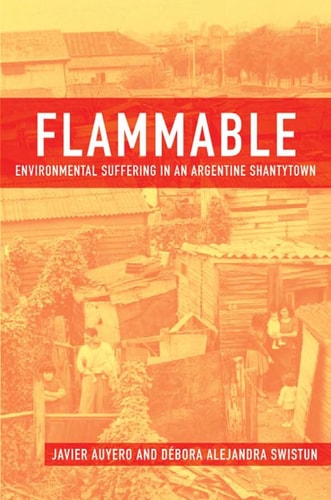
Flammable: Environmental Suffering in an Argentine Shantytown
0
0
As an Amazon Associate and affiliate partner, Menrva Books earns from qualifying purchases. Learn more
Author Description
Surrounded by one of the largest petrochemical compounds in Argentina, a highly polluted river that brings the toxic waste of tanneries and other industries, a hazardous and largely unsupervised waste incinerator, and an unmonitored landfill, Flammable's soil, air, and water are contaminated with lead, chromium, benzene, and other chemicals. So are its nearly five thousand sickened and frail inhabitants. How do poor people make sense of and cope with toxic pollution? Why do they fail to understand what is objectively a clear and present danger? How are perceptions and misperceptions shared within a community?Based on archival research and two and a half years of collaborative ethnographic fieldwork in Flammable, this book examines the lived experiences of environmental suffering. Despite clear evidence to the contrary, residents allow themselves to doubt or even deny the hard facts of industrial pollution. This happens, the authors argue, through a "labor of confusion" enabled by state officials who frequently raise the issue of relocation and just as frequently suspend it; by the companies who fund local health care but assert that the area is unfit for human residence; by doctors who say the illnesses are no different from anywhere else but tell mothers they must leave the neighborhood if their families are to be cured; by journalists who randomly appear and focus on the most extreme aspects of life there; and by lawyers who encourage residents to hold out for a settlement. These contradictory actions, advice, and information work together to shape the confused experience of living in danger and ultimately translates into a long, ineffective, and uncertain waiting time, a time dictated by powerful interests and shared by all marginalized groups.With luminous and vivid descriptions of everyday life in the neighborhood, Auyero and Swistun depict this on-going slow motion human and environmental disaster and dissect the manifold ways in which it is experienced by Fla
Menrva's Summary
THE THESIS
This book investigates how residents of a highly polluted Argentine shantytown perceive, interpret, and cope with the toxic environmental hazards surrounding their daily lives. Javier Auyero, a sociologist, and Debora Alejandra Swistun, an anthropologist, utilize two and a half years of ethnographic fieldwork and archival research to analyze the social and political mechanisms that produce collective confusion regarding industrial contamination. They argue that a 'labor of confusion'—sustained by state officials, corporations, and medical professionals—prevents residents from fully acknowledging the danger, effectively trapping them in a state of prolonged, uncertain waiting.
THE SCOPE MAP
What You Will Find
- Detailed ethnographic analysis of the Flammable neighborhood in Argentina.
- Examination of the 'labor of confusion' as a social and political tool.
- Qualitative data derived from long-term participant observation and interviews.
- Exploration of the intersection between environmental degradation and social marginalization.
THE AUTHORITY PERSPECTIVE
Experts in environmental sociology and urban studies frequently cite this work as a foundational text for understanding the social construction of environmental risk in marginalized communities. Readers often note the clarity of the authors' prose and the depth of their engagement with the residents' lived experiences.
Page Count:
208
Publication Date:
2009-04-10
Publisher:
Oxford University Press
ISBN-10:
0195372948
ISBN-13:
9780195372946
Slums
Public Health
Anthropology
United States
Sociology
Community Tags
Similar Books