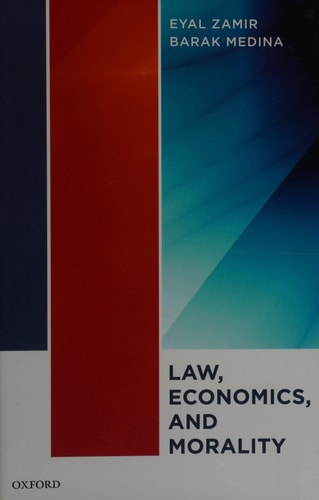
Law, Economics, and Morality
0
0
As an Amazon Associate and affiliate partner, Menrva Books earns from qualifying purchases. Learn more
Author Description
Law, Economics, and Morality examines the possibility of combining economic methodology and deontological morality through explicit and direct incorporation of moral constraints into economic models. Economic analysis of law is a powerful analytical methodology. However, as a purely consequentialist approach, which determines the desirability of acts and rules solely by assessing the goodness of their outcomes, standard cost-benefit analysis (CBA) is normatively objectionable. Moderate deontology prioritizes such values as autonomy, basic liberties, truth-telling, and promise-keeping over the promotion of good outcomes. It holds that there are constraints on promoting the good. Such constraints may be overridden only if enough good (or bad) is at stake. While moderate deontology conforms to prevailing moral intuitions and legal doctrines, it is arguably lacking in methodological rigor and precision.Eyal Zamir and Barak Medina argue that the normative flaws of economic analysis can be rectified without relinquishing its methodological advantages and that moral constraints can be formalized so as to make their analysis more rigorous. They discuss various substantive and methodological choices involved in modeling deontological constraints. Zamir and Medina propose to determine the permissibility of any act or rule infringing a deontological constraint by means of mathematical threshold functions. Law, Economics, and Morality presents the general structure of threshold functions, analyzes their elements and addresses possible objections to this proposal. It then illustrates the implementation of constrained CBA in several legal fields, including contract law, freedom of speech, antidiscrimination law, the fight against terrorism, and legal paternalism.
Menrva's Summary
THE THESIS
This book investigates whether economic methodology can be reconciled with deontological morality by integrating moral constraints directly into economic models. Authors Eyal Zamir and Barak Medina, both established scholars in legal theory and economics, argue that standard cost-benefit analysis is normatively limited by its purely consequentialist focus. They propose a formal framework using mathematical threshold functions to incorporate deontological values—such as autonomy and truth-telling—into legal and economic analysis, thereby enhancing the rigor of moral decision-making within legal systems.
THE SCOPE MAP
What You Will Find
- A formal framework for integrating deontological constraints into cost-benefit analysis using mathematical threshold functions.
- Methodological analysis of how to model moral values like autonomy, liberty, and promise-keeping.
- Practical application of constrained cost-benefit analysis across diverse legal domains including contract law, freedom of speech, and anti-discrimination law.
- Evaluation of legal paternalism and counter-terrorism measures through the lens of moral-economic synthesis.
THE AUTHORITY PERSPECTIVE
Legal scholars and economists view this work as a significant contribution to the intersection of normative ethics and law. Readers frequently note the technical density of the mathematical modeling, which serves as a foundational text for those seeking to bridge the gap between consequentialist economic analysis and deontological legal theory.
Page Count:
376
Publication Date:
2010-02-24
Publisher:
Oxford University Press
ISBN-10:
0195372166
ISBN-13:
9780195372168
Philosophy
Economics
Law Philosophy
Law and ethics
Economics
Ethics
Professional Career & Trade
Legal Theory
Law
Community Tags
Similar Books