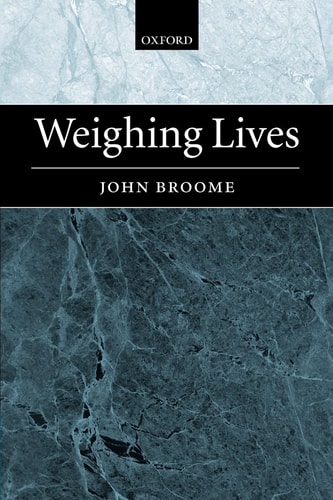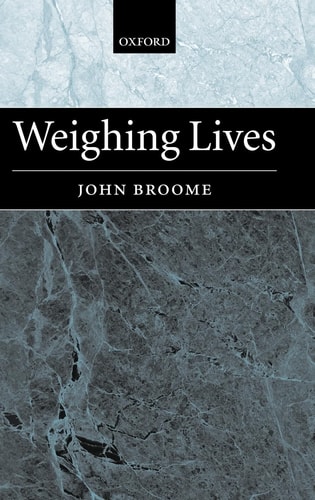
Weighing Lives
0
0
As an Amazon Associate and affiliate partner, Menrva Books earns from qualifying purchases. Learn more
Author Description
We are often faced with choices that involve the weighing of people's lives against each other, or the weighing of lives against other good things. These are choices both for individuals and for societies. We have to choose between the convenience to ourselves of road and air travel, and the lives of the future people who will be killed by the global warming we cause. We make choices that affect how many lives there will be in the future: as individuals we choose how many children to have, and societies choose tax policies that influence people's choices about having children. How should we weigh lives? John Broome develops a theoretical basis for answering this practical question. Using some of the precise methods of economic theory (accessible without mathematical expertise), Broome's conclusions will be highly significant for political theorists and economists as well as for philosophers, and anyone concerned with the value of life.
Menrva's Summary
THE THESIS
How should individuals and societies ethically weigh the value of human lives against one another and against other societal goods? John Broome, a philosopher and economist, constructs a theoretical framework to address the moral complexities of population ethics and public policy. By applying economic methodology to philosophical inquiry, he provides a structured approach for evaluating trade-offs in climate change, reproductive choices, and tax policy without requiring advanced mathematical training.
THE SCOPE MAP
What You Will Find
- Theoretical frameworks for evaluating the value of human life in public policy
- Economic methodologies applied to ethical decision-making
- Analysis of the moral implications of climate change and global warming
- Examination of reproductive choices and population growth policies
THE AUTHORITY PERSPECTIVE
Experts recognize this work as a foundational text for those navigating the intersection of welfare economics and moral philosophy. Readers frequently note that while the subject matter is complex, the author maintains an accessible prose style that avoids unnecessary technical jargon.
Page Count:
286
Publication Date:
2004-10-07
Publisher:
Clarendon Press
ISBN-10:
019924376X
ISBN-13:
9780199243761
Philosophy
Economics
Economics
Political Theory
Ethics
Social Science