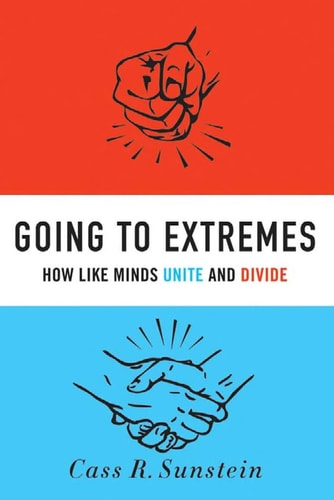
Going to Extremes: How Like Minds Unite and Divide
0
0
As an Amazon Associate and affiliate partner, Menrva Books earns from qualifying purchases. Learn more
Author Description
Why do people become extremists? What makes people become so dismissive of opposing views? Why is political and cultural polarization so pervasive in America?In Going to Extremes, renowned legal scholar and best-selling author Cass R. Sunstein offers startling insights into why and when people gravitate toward extremism. Sunstein marshals a wealth of evidence that shows that when like-minded people gather in groups, they tend to become more extreme in their views than they were before. Thus when liberals group get together to debate climate change, they end up more alarmed about climate change, while conservatives brought together to discuss same-sex unions become more set against same-sex unions. In courtrooms, radio stations, and chatrooms, enclaves of like-minded people are breeding ground for extreme movements. Indeed, Sunstein shows that a good way to create an extremist group, or a cult of any kind, is to separate members from the rest of society, either physically or psychologically. Sunstein's findings help to explain such diverse phenomena as political outrage on the Internet, unanticipated "blockbusters" in the film and music industry, the success of the disability rights movement, ethnic conflict in Iraq and former Yugoslavia, and Islamic terrorism.Providing a wealth of real-world examples--sometimes entertaining, sometimes alarming--Sunstein offers a fresh explanation of why partisanship has become so bitter and debate so rancorous in America and abroad.
Menrva's Summary
THE THESIS
This book investigates the psychological and social mechanisms that cause groups of like-minded individuals to shift toward increasingly extreme positions. Cass R. Sunstein, a prominent legal scholar, utilizes behavioral economics and social psychology to demonstrate how group deliberation often amplifies existing biases rather than moderating them. By analyzing the dynamics of social enclaves, he provides a framework for understanding how polarization functions in both democratic institutions and radical movements.
THE SCOPE MAP
What You Will Find
- Analysis of group polarization theory and its impact on collective decision-making.
- Examination of how physical and psychological isolation fosters extremist ideologies.
- Case studies ranging from political discourse and Internet culture to international ethnic conflicts.
- Exploration of the influence of social cascades on public opinion and market trends.
THE AUTHORITY PERSPECTIVE
Experts and political commentators frequently cite this work as a foundational text for understanding the mechanics of modern political polarization. Readers often note that the prose is accessible yet rigorous, providing a clear explanation of complex social phenomena that remain highly relevant to contemporary public discourse.
Page Count:
208
Publication Date:
2009-05-13
Publisher:
Oxford University Press
ISBN-10:
0195378016
ISBN-13:
9780195378016
Psychology
Non-Fiction
Sociology
Social Science
Radicalism
Community Tags
Other Editions(2)

Similar Books