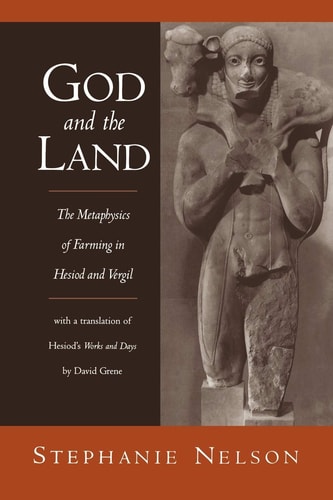
God and the Land: The Metaphysics of Farming in Hesiod and Vergil
0
0
As an Amazon Associate and affiliate partner, Menrva Books earns from qualifying purchases. Learn more
Author Description
In this pathbreaking book, which includes a powerful new translation of Hesiod's Works and Days by esteemed translator David Grene, Stephanie Nelson argues that a society's vision of farming contains deep indications about its view of the human place within nature, and our relationship to the divine. She contends that both Hesiod in the Works and Days and Vergil in the Georgics saw farming in this way, and so wrote their poems not only about farming itself, but also about its deeper ethical and religious implications.Hesiod, Nelson argues, saw farming as revealing that man must live by the sweat of his brow, and that good, for human beings, must always be accompanied by hardship. Within this vision justice, competition, cooperation, and the need for labor take their place alongside the uncertainties of the seasons and even of particular lucky and unlucky days to form a meaningful whole within which human life is an integral part. Vergil, Nelson argues, deliberately modeled his poem upon the Works and Days, and did so in order to reveal that his is a very different vision. Hesiod saw the hardship in farming; Vergil sees its violence as well. Farming is for him both our life within nature, and also our battle against her. Against the background of Hesiods poem, which found a single meaning for human life, Vergil thus creates a split vision and suggests that human beings may be radically alienated from both nature and the divine. Nelson argues that both the Georgics and the Works and Days have been misread because scholars have not seen the importance of the connection between the two poems, and because they have not seen that farming is the true concern of both, farming in its deepest and most profoundly unsettling sense.
Menrva's Summary
THE THESIS
Does the practice of agriculture serve as a fundamental lens through which ancient societies defined their ethical, religious, and existential relationship with the divine and the natural world? Stephanie A. Nelson, building upon a new translation of Hesiod by David Grene, examines the metaphysical dimensions of farming in Hesiod's Works and Days and Vergil's Georgics. She argues that these poets utilized the agricultural framework to articulate distinct, often conflicting, visions of human labor, justice, and alienation from nature. By analyzing these texts as interconnected meditations on the human condition, Nelson challenges traditional scholarly interpretations that overlook the profound philosophical weight of their agricultural subject matter.
THE SCOPE MAP
What You Will Find
- A comparative analysis of Hesiod's Works and Days and Vergil's Georgics as foundational texts on human labor and ethics.
- An examination of the transition from Hesiod's view of farming as a necessary, hardship-filled integration with nature to Vergil's portrayal of farming as a violent, potentially alienating struggle.
- A new translation of Hesiod's Works and Days by David Grene provided as a primary source for the study.
- A thematic exploration of how concepts like justice, competition, and divine uncertainty are embedded within the physical realities of seasonal agricultural cycles.
THE AUTHORITY PERSPECTIVE
Scholars recognize this work as a significant contribution to the study of classical literature, particularly for its focus on the philosophical implications of agricultural imagery. Readers frequently note the academic density of the prose, which demands a high level of familiarity with both the original Greek and Latin texts to fully appreciate the comparative arguments presented.
Page Count:
272
Publication Date:
2008-12-01
Publisher:
Oxford University Press
ISBN-10:
0195373340
ISBN-13:
9780195373349
Philosophy
Poetry
In literature
Gods Roman
Literary Criticism
Criticism history
Gods Greek
Mythology Classical
Agriculture
Community Tags
Other Editions(2)
Similar Books





Reader Comments
Share Your Thoughts
No comments yet. Be the first to share your thoughts!