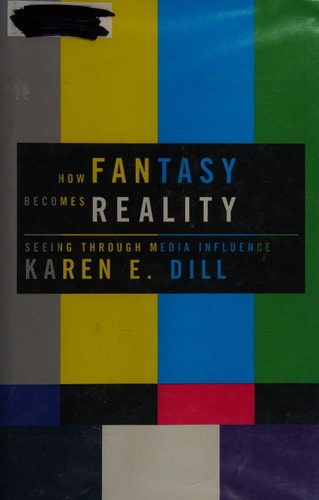
How Fantasy Becomes Reality: Seeing Through Media Influence
0
0
As an Amazon Associate and affiliate partner, Menrva Books earns from qualifying purchases. Learn more
Author Description
It's a common belief that the stories we encounter through mass media--whether in video games, action movies, or political comedy skits on Saturday Night Live--are just entertaining fantasies that have no tangible impact on our everyday lives, attitudes, and choices. Not so, says Karen Dill in this lively and provocative book. As much as we may want to deny it, the images, sounds, and narratives that bombard us daily have ample power to alter our realities.Dill, the author of the single-most-cited study on the effects of video-game violence, draws on extensive research in social psychology to show not only the myriad ways--for good and ill--that media influence us, but also why we resist believing they do. Vibrantly written and packed with eye-opening examples from everyday life, her wide-ranging analysis encompasses everything from gender and racial stereotyping to social identity, domestic violence, and presidential politics. She discusses the ways that super-thin models and actresses have altered women's self-images, dissects the manipulative strategies of advertising aimed at children and medical consumers, and explains how the "fake news" of The Daily Show and The Colbert Report may offer more authentic and incisive coverage than the cable channels and network newscasts. She also assesses the growing importance of "new media" like text-messaging, blogs, and Facebook in how we communicate and process information.In a media-saturated society, Dill argues, understanding precisely how these powerful forces affect us and learning how to deal with them are vital to the very way we function as citizens. How Fantasy Becomes Reality shows what we can do to move from the passenger's seat to the driver's seat as media consumers.
Menrva's Summary
THE THESIS
How do mass media narratives and images fundamentally shape individual perception, social identity, and political behavior in a media-saturated society? Karen E. Dill, a prominent social psychologist known for her research on media violence, argues that media consumption is not a passive act of entertainment but a powerful force that alters human reality. By synthesizing extensive psychological research, she demonstrates that individuals often underestimate the impact of media on their own attitudes and choices. The book provides a framework for recognizing these influences, ranging from advertising and gender stereotypes to the role of digital communication, ultimately advocating for a more conscious and critical approach to media consumption.
THE SCOPE MAP
What You Will Find
- Analysis of psychological mechanisms behind media influence and cognitive resistance.
- Examination of gender and racial stereotyping in film, television, and advertising.
- Evaluation of the impact of new media platforms, including social networking and digital messaging.
- Discussion of the intersection between political satire and public perception of news.
THE AUTHORITY PERSPECTIVE
Experts and academics recognize this work as a highly accessible synthesis of social psychology applied to contemporary media consumption. Readers frequently note that the text successfully bridges the gap between rigorous research and everyday observation, making it a standard resource for understanding modern media literacy.
Page Count:
320
Publication Date:
2009-09-03
Publisher:
Oxford University Press
ISBN-10:
0195372085
ISBN-13:
9780195372083
Media Studies
Sociology
Communication
Mass media
Community Tags
Similar Books