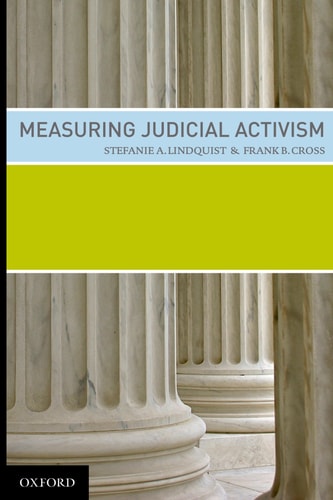
Measuring Judicial Activism
0
0
As an Amazon Associate and affiliate partner, Menrva Books earns from qualifying purchases. Learn more
Author Description
Measuring Judicial Activism supplies empirical analysis to the widely discussed concept of judicial activism at the United States Supreme Court. Complaints about activist Court decisions are common within contemporary political discourse, but these objections often have little substantive meaning beyond the speaker's disagreement with particular case outcomes. Frequently debated by legal scholars, judicial activism is shaped by the participants' ideological perspectives as well as by their subjective views regarding ambiguous constitutional provisions. Although no study can be perfectly objective, Measuring Judicial Activism seeks to move beyond these more subjective debates by conceptualizing activism in non-ideological terms, identifying specific empirical dimensions to the concept, and measuring those dimensions using systematic social scientific techniques. In so doing, the book allows the authors to assess the relative "activism" of recent justices on the Court.Stefanie Lindquist and Frank B. Cross's work is guided theoretically by the notion that, at its core, the concept of activism involves concerns over the judiciary's institutional aggrandizement at the expense of the elected branches. An important corollary idea is that such efforts are particularly "activist" when they further the justices' own policy or ideological objectives. From these core theoretical ideas, the authors identify specific empirical manifestations that reflect the expansion of judicial power. In particular, the authors evaluate the Court's exercise of judicial review to invalidate legislative and executive action. Lindquist and Cross also analyze the justices' willingness to expand the Court's power by granting litigants increased access to the courts and overruling the Court's own precedents. In these contexts, Measuring Judicial Activism considers the extent to which these actions are consistent with the justices' ideological predilections.
Menrva's Summary
THE THESIS
This book investigates whether judicial activism can be defined and quantified through empirical analysis rather than subjective political disagreement. The authors, Frank B. Cross and Stefanie A. Lindquist, utilize social scientific methodologies to examine the United States Supreme Court. They argue that activism is best understood as institutional aggrandizement, specifically when the judiciary expands its power at the expense of elected branches to further ideological objectives. By identifying observable manifestations of this behavior, the authors provide a framework for assessing the relative activism of individual justices.
THE SCOPE MAP
What You Will Find
- Empirical dimensions of judicial activism including the invalidation of legislative and executive actions.
- Analysis of the Court's willingness to grant increased litigant access and overturn its own precedents.
- Systematic social scientific techniques applied to Supreme Court decision-making data.
- A theoretical framework linking institutional power expansion to the ideological predilections of justices.
THE AUTHORITY PERSPECTIVE
Legal scholars and political scientists frequently cite this work as a foundational text for applying quantitative methods to the study of judicial behavior. Readers often note the technical rigor of the prose, which provides a clear, non-ideological lens for evaluating complex constitutional questions.
Page Count:
192
Publication Date:
2009-04-13
Publisher:
Oxford University Press
ISBN-10:
0195370856
ISBN-13:
9780195370850
Empirical Research
United States
Law
Supreme Court
Community Tags
Similar Books