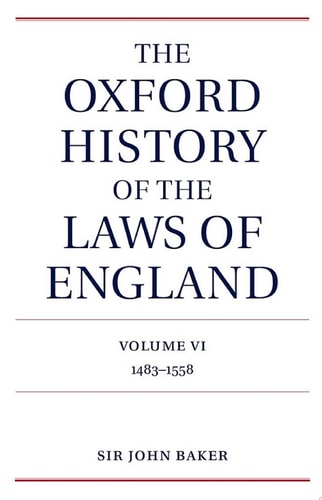
The Oxford History of the Laws of England: Volume VI: 1483-1558
0
0
As an Amazon Associate and affiliate partner, Menrva Books earns from qualifying purchases. Learn more
Author Description
This volume covers the years 1483-1558, a period of immense social, political, and intellectual changes, which profoundly affected the law and its workings. It first considers constitutional developments, and addresses the question of whether there was a rule of law under king Henry VIII. In a period of supposed despotism, and enhanced parliamentary power, protection of liberty was increasing and habeas corpus was emerging. The volume considers the extent to which the law was affected by the intellectual changes of the Renaissance, and how far the English experience differed from that of the Continent. It includes a study of the myriad jurisdictions in Tudor England and their workings; and examines important procedural changes in the central courts, which represent a revolution in the way that cases were presented and decided. The legal profession, its education, its functions, and its literature are examined, and the impact of printing upon legal learning and the role of case-law in comparison with law-school doctrine are addressed. The volume then considers the law itself. Criminal law was becoming more focused during this period as a result of doctrinal exposition in the inns of court and occasional reports of trials. After major conflicts with the Church, major adjustments were made to the benefit of clergy, and the privilege of sanctuary was all but abolished. The volume examines the law of persons in detail, addressing the impact of the abolition of monastic status, the virtual disappearance of villeinage, developments in the law of corporations, and some remarkable statements about the equality of women. The history of private law during this period is dominated by real property and particularly the Statutes of Uses and Wills (designed to protect the king's feudal income against the consequences of trusts) which are given a new interpretation. Leaseholders and copyholders came to be treated as full landowners with rights assimilated to those of freeholders.
Menrva's Summary
THE THESIS
This volume investigates how the legal landscape of England transformed amidst the profound social, political, and intellectual shifts occurring between 1483 and 1558. John R.J. Baker, a distinguished legal historian, utilizes primary source records, court documents, and contemporary legal literature to analyze the evolution of the English judicial system during the Tudor era. The work argues that despite the period's reputation for despotism, significant advancements in parliamentary power, the protection of individual liberty, and procedural reform occurred simultaneously.
THE SCOPE MAP
What You Will Find
- Analysis of constitutional developments and the emergence of habeas corpus under Henry VIII.
- Examination of the legal profession, including education, functions, and the impact of printing on legal learning.
- Detailed study of the law of persons, covering the abolition of monastic status and the status of women.
- Investigation into private law, specifically real property, the Statutes of Uses and Wills, and the rights of leaseholders and copyholders.
Scope Limits
- The analysis is strictly confined to the period between 1483 and 1558.
- The text focuses primarily on English law and does not provide a comprehensive comparative study of all Continental legal systems.
THE AUTHORITY PERSPECTIVE
Legal scholars and historians recognize this volume as a definitive, high-density reference work for the Tudor period. Experts frequently cite the text for its meticulous examination of procedural changes and its nuanced interpretation of property law statutes.
Page Count:
1046
Publication Date:
2003-01-01
Publisher:
OUP Oxford
ISBN-10:
0191018570
ISBN-13:
9780191018572
History
Legal History
Constitutional History
Law
Tudor England
British History
Professional Career & Trade
Community Tags
Other Editions(2)
Similar Books





Reader Comments
Share Your Thoughts
No comments yet. Be the first to share your thoughts!