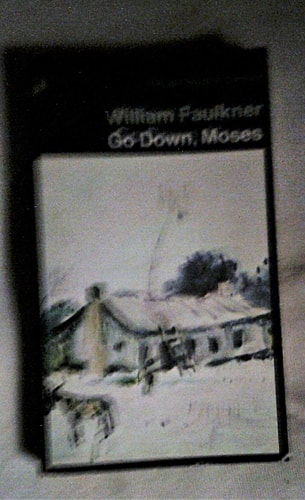
Go Down, Moses
0
0
As an Amazon Associate and affiliate partner, Menrva Books earns from qualifying purchases. Learn more
Author Description
“I believe that man will not merely endure: he will prevail. He is immortal, not because he alone among creatures has an inexhaustible voice, but because he has a soul, a spirit capable of compassion and sacrifice and endurance.” — William Faulkner, on receiving the Nobel Prize. Go Down, Moses is composed of seven interrelated stories, all of them set in Faulkner’s mythic Yoknapatawpha County. From a variety of perspectives, Faulkner examines the complex, changing relationships between blacks and whites, between man and nature, weaving a cohesive novel rich in implication and insight.
Menrva's Summary
THE PULSE
The central conflict emerges from the collision of ancestral legacies, racial tensions, and the encroaching destruction of the wilderness within the fictional landscape of Yoknapatawpha County. Through seven interconnected narratives, the text tracks the McCaslin family lineage and their complex entanglement with the land and the people they have historically oppressed. The protagonist, often represented by Isaac McCaslin, seeks to reconcile his inheritance with the moral weight of his family's past. The narrative framework utilizes shifting perspectives and non-linear chronology to explore the physical and psychological constraints imposed by the rigid social hierarchies of the American South.
INSIDE THE PAGES
- Interconnected short story structure forming a cohesive novel
- Exploration of the McCaslin family genealogy
- Focus on the decline of the Southern wilderness
- Examination of racial identity and historical guilt
- Use of stream-of-consciousness prose
- Complex, multi-generational timeline
- Symbolic representation of the land as a character
- Philosophical inquiry into human endurance and moral responsibility
THE COLLECTIVE ECHO
Discussion often centers on the intricate structure of the collection and how the individual stories function as a unified exploration of Southern history. Readers frequently highlight the density of the prose and the challenging nature of the shifting narrative viewpoints throughout the text. Critics often focus on the thematic weight of the wilderness and the moral evolution of the central characters as they confront their heritage. The work is widely regarded for its examination of the intersection between personal conscience and systemic societal failures. Many readers find the atmospheric world-building to be a defining characteristic that anchors the disparate stories into a singular, cohesive vision.
Page Count:
288
Publication Date:
1985-01-01
Publisher:
Penguin Putnam~trade
ISBN-10:
0140014349
ISBN-13:
9780140014341
Literary Fiction
Historical
American
Short Story
Southern Gothic