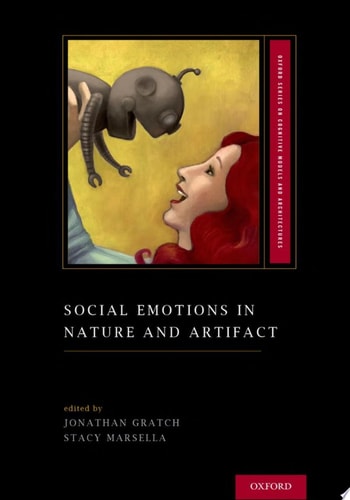
Social Emotions in Nature and Artifact
0
0
As an Amazon Associate and affiliate partner, Menrva Books earns from qualifying purchases. Learn more
Author Description
Recent years have seen the rise of a remarkable partnership between the social and computational sciences on the phenomena of emotions. Rallying around the term Affective Computing, this research can be seen as revival of the cognitive science revolution, albeit garbed in the cloak of affect, rather than cognition. Traditional cognitive science research, to the extent it considered emotion at all, cases it as at best a heuristic but more commonly a harmful bias to cognition. More recent scholarship in the social sciences has upended this view.Increasingly, emotions are viewed as a form of information processing that serves a functional role in human cognition and social interactions. Emotions shape social motives and communicate important information to social partners. When communicating face-to-face, people can rapidly detect nonverbal affective cues, make inferences about the other party's mental state, and respond in ways that co-construct an emotional trajectory between participants. Recent advances in biometrics and artificial intelligence are allowing computer systems to engage in this nonverbal dance, on the one hand opening a wealth of possibilities for human-machine systems, and on the other, creating powerful new tools for behavioral science research.Social Emotions in Nature and Artifact reports on the state-of-the-art in both social science theory and computational methods, and illustrates how these two fields, together, can both facilitate practical computer/robotic applications and illuminate human social processes.
Menrva's Summary
THE THESIS
This volume investigates the functional role of emotions in human cognition and social interaction, specifically examining how these processes can be modeled and replicated in artificial systems. The authors, Jonathan Gratch and Stacy Marsella, synthesize perspectives from social science and computational research to challenge the traditional view of emotion as a cognitive bias. By framing affect as a sophisticated form of information processing, the text argues that integrating these disciplines provides a robust framework for both understanding human behavior and advancing human-machine interaction.
THE SCOPE MAP
What You Will Find
- Theoretical frameworks linking affective computing to cognitive science.
- Methodologies for modeling nonverbal affective cues in artificial agents.
- Analysis of how emotions function as information processing mechanisms in social contexts.
- Case studies illustrating the application of biometric and AI technologies in behavioral research.
THE AUTHORITY PERSPECTIVE
Experts recognize this work as a significant contribution to the intersection of social psychology and computational modeling. Readers frequently note the academic density of the prose, which serves as a foundational reference for researchers working in affective computing and human-robot interaction.
Page Count:
224
Publication Date:
2013-11-29
Publisher:
Oxford University Press
ISBN-10:
0195387643
ISBN-13:
9780195387643
Psychology
Social Science
Computer Science
Community Tags
Similar Books