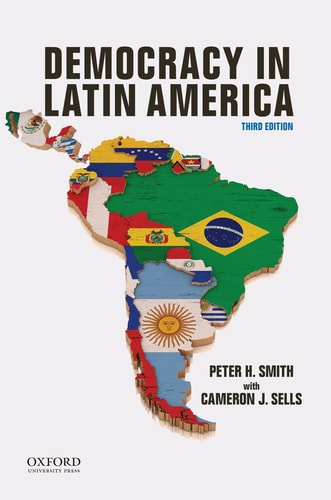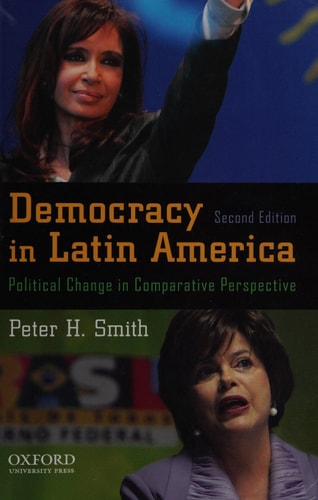
Democracy in Latin America: Political Change in Comparative Perspective
0
0
As an Amazon Associate and affiliate partner, Menrva Books earns from qualifying purchases. Learn more
Author Description
Thoroughly updated in its second edition, Democracy in Latin America provides an in-depth and accessible survey of processes of democratization in Latin America from 1900 to the present. In clear and jargon-free prose, acclaimed author Peter H. Smith examines the origins and evolution of democracy in Latin America; the adoption and reform of electoral institutions; the policy performance of contemporary democracies; the political representation of women, workers, and indigenous peoples; and trends in public opinion.Adroitly blending qualitative and quantitative approaches, Democracy in Latin America, Second Edition, offers an innovative perspective on democratic change in Latin America. Enhanced by photos and text boxes featuring portraits of personalities, explanations about methodology, and comments on conceptual approaches, it is ideal for undergraduate and graduate courses in political science, history, Latin American studies, and history.FEATURES OF THE SECOND EDITION:* Updates empirical information on present-day developments, such as women's representation, the empowerment of indigenous peoples, and anti-poverty policies* Interprets the emergence of the "new Left" as part of a recurring dialectic within Latin American democracy* Analyzes the changing roles of the judiciary* Considers the relationship between social status and satisfaction with democracy* Reassesses the relative balance between "liberal" and "illiberal" democracy throughout the region* Provides a completely new analysis of public opinion on the basis of raw survey data* Takes into account the contemporary international environment, inlcuding the rise of China
Menrva's Summary
THE THESIS
This book investigates the complex evolution, institutional frameworks, and performance of democratic systems across Latin America from the early 20th century to the present day. Peter H. Smith, a distinguished scholar in the field of Latin American studies, synthesizes historical data and contemporary political trends to evaluate the region's democratic trajectory. By employing a comparative methodology, the author examines how electoral institutions, social movements, and international pressures have shaped the current political landscape. The work argues that democracy in the region is not a static achievement but a dynamic, recurring dialectic influenced by both internal social shifts and external global factors.
THE SCOPE MAP
What You Will Find
- A comprehensive longitudinal analysis of democratization processes from 1900 to the present.
- Comparative assessments of electoral institutions and judicial roles across various Latin American nations.
- Empirical data analysis regarding public opinion, social status, and political representation of marginalized groups.
- Evaluation of the 'new Left' emergence and the shifting balance between liberal and illiberal democratic practices.
THE AUTHORITY PERSPECTIVE
Experts and educators frequently cite this work as a foundational text for undergraduate and graduate courses due to its accessible prose and rigorous comparative framework. Readers often note the balance between qualitative historical narrative and quantitative data analysis, making it a standard reference for understanding regional political development.
Page Count:
400
Publication Date:
2011-09-08
Publisher:
Oxford University Press
ISBN-10:
0195387732
ISBN-13:
9780195387735
History
Latin America
Democracy
Government
Community Tags
Similar Books