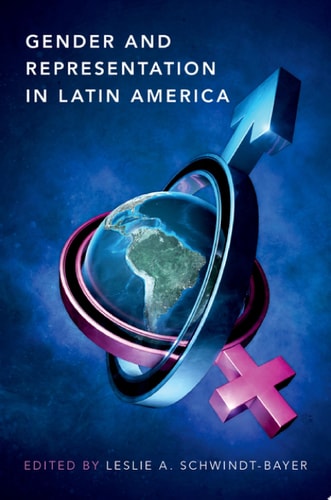
Gender and Representation in Latin America
0
0
As an Amazon Associate and affiliate partner, Menrva Books earns from qualifying purchases. Learn more
Author Description
In the past thirty years, women's representation and gender equality has developed unevenly in Latin America. Some countries have experienced large increases in gender equality in political offices, whereas others have not, and even within countries, some political arenas have become more gender equal whereas others continue to exude intense gender inequality. These patterns are inconsistent with explanations of social and cultural improvements in gender equality leading to improved gender equality in political office. Gender and Representation in Latin America argues instead that gender inequality in political representation in Latin America is rooted in institutions and the democratic challenges and political crises facing Latin American countries and that these challenges matter for the number of women and men elected to office, what they do once there, how much power they gain access to, and how their presence and actions influence democracy and society more broadly. The book draws upon the expertise of top scholars of women, gender, and political institutions in Latin America to analyze the institutional and contextual causes and consequences of women's representation in Latin America. It does this in part 1 with chapters that analyze gender and political representation regionwide in each of five different "arenas of representation"-the presidency, cabinets, national legislatures, political parties, and subnational governments. In part 2, it provides chapters that analyze gender and representation in each of seven different countries-Argentina, Chile, Costa Rica, Uruguay, Mexico, Brazil, and Colombia. The authors bring novel insights and impressive new data to their analyses, helping to make this one of the most comprehensive books on gender and political representation in Latin America today.
Menrva's Summary
THE THESIS
This book investigates why women's political representation and gender equality have developed unevenly across Latin American nations over the past three decades. Leslie A. Schwindt-Bayer and a team of expert contributors argue that these disparities are not merely the result of social or cultural shifts, but are deeply rooted in political institutions, democratic challenges, and recurring crises. The text provides a comprehensive framework for understanding how these structural factors dictate the number of women elected to office, their subsequent legislative power, and their overall impact on democratic governance.
THE SCOPE MAP
What You Will Find
- Comparative analysis of five political arenas: presidency, cabinets, national legislatures, political parties, and subnational governments.
- Country-specific case studies covering Argentina, Chile, Costa Rica, Uruguay, Mexico, Brazil, and Colombia.
- Quantitative data sets regarding gender parity in political offices.
Scope Limits
- The analysis does not cover non-political social movements or grassroots activism outside of formal institutional structures.
- The study is geographically restricted to the seven specified Latin American nations and does not provide a global comparative analysis.
THE AUTHORITY PERSPECTIVE
Experts identify this work as a foundational text for understanding the intersection of institutional design and gender representation in the region. Readers frequently note the academic density of the prose and the rigor of the multi-country data analysis.
Page Count:
350
Publication Date:
2018-02-02
Publisher:
Oxford University Press
ISBN-10:
0190851228
ISBN-13:
9780190851224
American Studies
Democracy
Gender Studies
Political Activity
Sociology
Latin America
Government
Community Tags
Similar Books