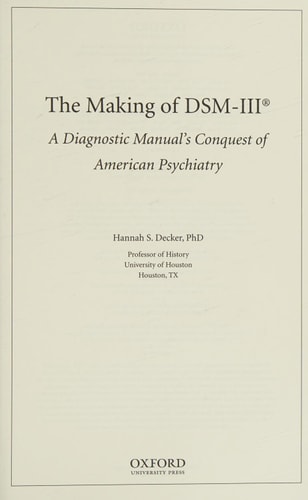
The Making of DSM-III: A Diagnostic Manual's Conquest of American Psychiatry
0
0
As an Amazon Associate and affiliate partner, Menrva Books earns from qualifying purchases. Learn more
Author Description
In 1973, the American Psychiatric Association decided to publish a revised edition of their Diagnostic and Statistical Manual (DSM). There was great hope that a new manual would display psychiatry as a scientific field and aid in combating the attacks of an aggressive anti-psychiatry movement that had persisted for more than a decade.The Making of DSM-III® is a book about the manual that resulted in 1980-DSM-III-a far-reaching revisionist work that created a revolution in American psychiatry. Its development precipitated a historic clash between the DSM-III Task Force--a group of descriptive, empirically oriented psychiatrists and psychologists--and the psychoanalysts the Task Force was determined to dethrone from their dominance in American psychiatry. DSM-III also inaugurated an era in which it and the diagnostic manuals that followed played enormous roles in the daily lives of persons and organizations all over the world, for the DSMs have been translated into many languages.The radical revision process was led by the psychiatrist Robert L. Spitzer, a many-talented man of great determination, energy, and tactical skills, arguably the most influential psychiatrist of the second half of the 20th Century. Spitzer created as major a change in descriptive psychiatry and classification as had the renowned German psychiatrist Emil Kraepelin, almost a century earlier. Kraepelin had been the epochal delineator of dementia praecox from manic-depressive illness, the forerunners of modern schizophrenia and bipolar disorder.In her book, Hannah Decker portrays the many internal and external battles that roiled the creation of DSM-III and analyzes both its positive achievements and significant drawbacks. She also astutely explores the deleterious effects of the violent swings in scientific orientation that have dominated psychiatry over the past 200 years and are still alive today.Decker has written a revealing and exciting book that is based on archival sources never before us
Menrva's Summary
THE THESIS
This book investigates the complex development of the DSM-III and its role in transforming American psychiatry from a psychoanalytic framework to a descriptive, empirical science. Hannah S. Decker, a historian of psychiatry, utilizes previously untapped archival sources to document the intense internal conflicts within the American Psychiatric Association during the 1970s. She argues that the manual's creation was not merely a technical update but a strategic maneuver to secure the professional legitimacy of psychiatry against external anti-psychiatry movements and internal theoretical divisions. The text examines how Robert L. Spitzer’s leadership shifted the field's diagnostic paradigm, mirroring the historical influence of Emil Kraepelin.
THE SCOPE MAP
What You Will Find
- A detailed historical account of the 1973-1980 period leading to the publication of the DSM-III.
- Analysis of the power struggle between the DSM-III Task Force and the established psychoanalytic community.
- Examination of the long-term impact of diagnostic manuals on global psychiatric practice and patient classification.
- Critical assessment of the cyclical shifts in scientific orientation that have shaped psychiatric theory over the last two centuries.
THE AUTHORITY PERSPECTIVE
Experts recognize this work as a definitive account of the political and scientific maneuvering required to standardize psychiatric diagnosis. Readers frequently note the meticulous use of archival evidence, which provides a balanced view of both the clinical advancements and the systemic drawbacks introduced by the DSM-III.
Page Count:
466
Publication Date:
2013-04-26
Publisher:
Oxford University Press
ISBN-10:
0195382234
ISBN-13:
9780195382235
Non-Fiction
Science
MEDICAL History
Psychiatry
Mental Illness
Community Tags
Similar Books