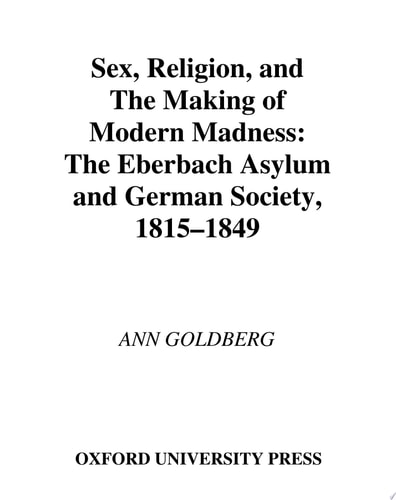
Sex, Religion, and the Making of Modern Madness: The Eberbach Asylum and German Society, 1815-1849
0
0
As an Amazon Associate and affiliate partner, Menrva Books earns from qualifying purchases. Learn more
Author Description
How did the affliction we now know as insanity move from a religious phenomenon to a medical one? How did social class, gender, and ethnicity affect the experience of mental trauma and the way psychiatrists diagnosed and treated patients? In answering these questions, this important volume mines the rich and unusually detailed records of one of Germany's first modern insane asylums, the Eberbach Asylum in the duchy of Nassau. It is a book on the historical relationship between madness and modernity that both builds upon and challenges Michel Foucault's landmark work on this topic, a bold study that gives generous consideration to madness from the patient's perspective while also shedding new light on sexuality, politics, and antisemitism in nineteenth-century Germany. Drawing on the case records of several hundred asylum patients, Sex, Religion, and the Making of Modern Madness reconstructs the encounters of state officials and medical practitioners with peasant madness and deviancy during a transitional period in the history of both Germany and psychiatry. As author Ann Goldberg explains, this era witnessed the establishment of psychiatry as a legitimate medical specialty during a time of social upheaval, as Germany underwent the shift toward a capitalist order and the modern state. Focusing on such "illnesses" as religious madness, nymphomania, and masturbatory insanity, as well as the construct of Jewishness, she probes the daily encounters in which psychiatric categories were applied, experienced, and resisted within the settings of family, village, and insane asylum. The book is a model of microhistory, breaking new ground in the historiography of psychiatry as it synthetically applies approaches from "the history of everyday life," anthropology, poststructuralism, and feminist studies. In contrast to earlier, anecdotal studies of "the asylum patient," Goldberg employs diagnostic patterns to illuminate the ways in which madness--both in psychiatric practice and
Menrva's Summary
THE THESIS
This work investigates how the medicalization of insanity in nineteenth-century Germany transformed from a religious framework into a clinical one, reflecting broader shifts in social class, gender, and state power. Ann Goldberg, a historian specializing in German social history, utilizes the extensive archival records of the Eberbach Asylum to argue that psychiatric diagnosis was not merely a medical act but a social tool used to manage deviancy during Germany's transition to a capitalist state. By analyzing specific case studies, she demonstrates how psychiatrists and state officials imposed modern categories of illness upon peasant populations to enforce social order.
THE SCOPE MAP
What You Will Find
- Detailed analysis of patient records from the Eberbach Asylum in the duchy of Nassau between 1815 and 1849.
- Examination of diagnostic categories including religious madness, nymphomania, and masturbatory insanity.
- Application of methodologies from microhistory, anthropology, and feminist studies to psychiatric historiography.
Scope Limits
- The study is geographically confined to the duchy of Nassau and does not provide a comprehensive survey of all German psychiatric institutions.
- The analysis focuses primarily on the early nineteenth-century transition period and does not extend into the later developments of twentieth-century psychiatry.
THE AUTHORITY PERSPECTIVE
Scholars in the history of medicine frequently cite this volume as a significant contribution to the field for its rigorous use of primary source case records. Readers often note the academic density of the prose, which synthesizes complex poststructuralist theory with detailed archival research.
Page Count:
246
Publication Date:
2001-01-01
Publisher:
Oxford University Press
ISBN-10:
019028630X
ISBN-13:
9780190286309
History
Psychotherapist and patient
Germany
Sex
Mental Illness
Sociology
European History
History of Psychology
MEDICAL History
Gender Studies
Jewish History
Psychiatry
Community Tags
Similar Books