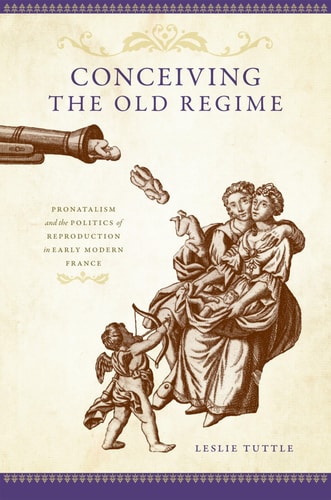
Conceiving the Old Regime: Pronatalism and the Politics of Reproduction in Early Modern France
0
0
As an Amazon Associate and affiliate partner, Menrva Books earns from qualifying purchases. Learn more
Author Description
Early modern rulers believed that the more subjects over whom they ruled, the more powerful they would be. In 1666, France's Louis XIV and his minister Jean-Baptiste Colbert put this axiom into effect, instituting policies designed to encourage marriage and very large families. Their Edict on Marriage promised lucrative rewards to French men of all social statuses who married before age twenty-one or fathered ten or more living, legitimate children. So began a 150-year experiment in governing the reproductive process, the largest populationist initiative since the Roman Empire.Conceiving the Old Regime traces the consequences of premodern pronatalism for the women, men, and government officials tasked with procreating the abundant supply of soldiers, workers, and taxpayers deemed essential for France's glory. While everyone knew-in a practical rather than a scientific sense-how babies were made, the notion that humans should exercise control over reproduction remained deeply controversial in a Catholic nation.Drawing on a wealth of archival sources, Leslie Tuttle shows how royal bureaucrats mobilized the limited power of the premodern state in an attempt to shape procreation in the king's interest. By the late eighteenth century, marriage, reproduction, and family size came to be hot-button political issues, inspiring debates that contributed to the character of the modern French nation.Conceiving the Old Regime reveals the deep historical roots of France's perennial concern with population, and connects the intimate lives of men and women to the public world of power and the state.
Menrva's Summary
THE THESIS
This book investigates how the French monarchy attempted to regulate human reproduction as a tool of state power during the early modern period. Leslie Tuttle, a historian specializing in early modern France, utilizes extensive archival research to examine the intersection of royal policy and private life. She argues that the state's efforts to incentivize large families to bolster military and economic strength fundamentally transformed the relationship between the individual and the government, laying the groundwork for modern political discourse on family and population.
THE SCOPE MAP
What You Will Find
- An analysis of the 1666 Edict on Marriage and its long-term implementation under Louis XIV and Colbert.
- Examination of the tension between Catholic doctrine and state-mandated reproductive control.
- Primary source evidence including administrative records, legal documents, and social correspondence from the 17th and 18th centuries.
- A study of how pronatalist policies influenced the development of the modern French state and national identity.
THE AUTHORITY PERSPECTIVE
Historians recognize this work as a significant contribution to the study of premodern statecraft and the history of the family. Scholars frequently cite the text for its ability to bridge the gap between intimate domestic experiences and the broader mechanisms of royal bureaucracy.
Page Count:
264
Publication Date:
2010-06-25
Publisher:
Oxford University Press
ISBN-10:
0195381602
ISBN-13:
9780195381603
History
French History
Social History
Political History
European History
Politics & Government
Gender Studies
Community Tags
Similar Books