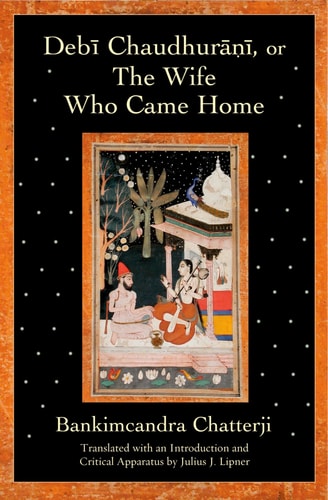
Debi Chaudhurani: The Wife Who Came Home
0
0
As an Amazon Associate and affiliate partner, Menrva Books earns from qualifying purchases. Learn more
Author Description
This is the second in a trilogy of works by the famed Bengali novelist Bankimcandra Chatterji (1838-1894), and the second to be translated by Julius Lipner. The first, Anandamath, or The Sacred Brotherhood was published by OUP in 2005. Bankim Chatterji was perhaps the foremost novelist and intellectual mediating western ideas to India in the latter half of the 19th century. Debi Chaudhurani is a didactic work that champions a particular interpretation of Hindu dharma and wifely duties reflective of the late 19th-century Calcutta context in which it was written. But the story is also compelling. Written in a conversational style, it features surprising plot twists and ideas that are, even today, revolutionary in their daring. Most notably, Bankim makes a woman the embodiment of Lord Krishna's salvific message, as originally enunciated in the Bhagavad Gita. The protagonist, Debi, is a complex figure who is a rejected wife, becomes a bandit queen, represents a goddess figure, and symbolizes the land of India. There is a creative tension between her strength as a leader and her correct role, from the perspective of the author, as a domestic wife. Bankim also focuses on caste and what it means to be a genuine Brahmin, who is transformed by the author into a man who executes responsibilities instead of demanding privileges. Within the context of the teachings of the Gita, the author shares his vision of social activism to improve India. Lipner's idiomatic translation is enhanced by his detailed commentary on the original Bengali text and by a readable introduction that sets the novel and its ideas in context.
Menrva's Summary
THE PULSE
A rejected wife transforms into a powerful bandit queen, forcing a confrontation between her newfound autonomy and the traditional expectations of her society. The protagonist, Prafulla, finds herself cast out from her domestic life, leading her to adopt the identity of the formidable Debi Chaudhurani. As she navigates the dangerous landscape of 19th-century Bengal, she must reconcile her role as a leader of outlaws with the spiritual and social mandates of Hindu dharma. The narrative, presented in a conversational tone, explores the tension between individual agency and the rigid structures of caste and gender that define her world.
INSIDE THE PAGES
- Exploration of the Bhagavad Gita as a framework for social activism
- Dual identity narrative featuring a protagonist who shifts from wife to bandit queen
- Critical examination of 19th-century Bengali social hierarchies and caste systems
- Integration of didactic philosophical discourse within a fictional plot
- Use of the protagonist as a symbolic representation of the Indian nation
- Incorporation of surprising plot twists to maintain narrative momentum
- Detailed commentary provided by the translator to explain cultural nuances
- Analysis of the conflict between personal strength and domestic duty
THE COLLECTIVE ECHO
Discussion often centers on the complex portrayal of the protagonist as both a powerful leader and a figure bound by traditional wifely duties. Readers frequently highlight the author's ability to weave dense philosophical inquiries into a narrative that remains accessible and engaging. Critics note the effectiveness of the work in mediating Western and Eastern intellectual traditions during a period of significant cultural transition. The text is widely recognized for its daring decision to place a woman at the center of a salvific message typically reserved for male figures in religious literature. This balance of character development and ideological exploration ensures the book remains a subject of interest for those studying the evolution of the Indian novel.
Page Count:
296
Publication Date:
2009-10-02
Publisher:
Oxford University Press
ISBN-10:
0195388364
ISBN-13:
9780195388367
Philosophy
Religion
classic
Adventure fiction
Indian
Married People
Social Commentary
Historical
India
Community Tags
Similar Books