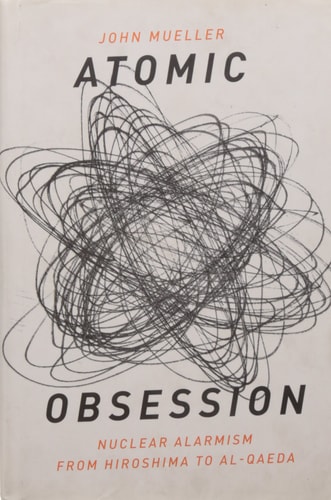
Atomic Obsession: Nuclear Alarmism from Hiroshima to Al-Qaeda
0
0
As an Amazon Associate and affiliate partner, Menrva Books earns from qualifying purchases. Learn more
Author Description
Following 9/11, Americans were swept up in a near hysteria-level fear of terrorists, especially of Islamic extremists working domestically. The government and media reports stoked fears that people living in the US have the desire and means to wreak extreme havoc and destruction. Early reports estimated slightly more than 300 al Qaeda operatives living in the United States. It wasn't long before this number became 2,000 or 5,000 domestic terrorists. As these estimates snowballed, so did spending on federal counterterrorism organizations and measures, spending which now totals over a trillion dollars. The federal government launched more covert operations in the name of fighting terrorist adversaries than they did in the entirety of the forty-five year Cold War. For each apprehension of a credible terrorist suspect, the US government created or re-organized two counterterrorism organizations. The scale of these efforts has been enormous, yet somehow they have not been proven to make Americans feels safe from what they perceive to be a massive terrorist threat. But how well-founded is this fear? Is the threat of terrorism in the United States as vast as it seems and are counterterrorism efforts effective and appropriately-scaled?It has not, statistically speaking, been efficient or successful. Only one alarm in 10,000 has proven to be a legitimate threat-the rest are what the authors refer to as "ghosts." These ghosts are enormous drains on resources and contribute to a countrywide paranoia that has resulted in widespread support and minimal critical questioning of massive expenditures and infringements on civil liberties, including invasions of privacy and questionably legal imprisonments. In Chasing Ghosts, John Mueller and Mark Stewart argue that the "ghost chase" occupying American fears, law enforcement, and federal spending persists because the public believes that there exists in the US a dire and significant threat of terrorism. The authors seek to analyze to
Menrva's Summary
THE THESIS
Does the persistent fear of nuclear terrorism and domestic extremism accurately reflect the statistical probability of such attacks, or is it a product of institutional alarmism? John E. Mueller, a political scientist known for his critical analysis of international security, examines the historical trajectory of nuclear anxiety from the dawn of the atomic age through the post-9/11 era. He argues that government agencies and media outlets have systematically inflated the threat of terrorism to justify massive increases in federal spending and the expansion of surveillance powers. By contrasting the actual frequency of credible threats against the scale of counterterrorism responses, the author challenges the prevailing narrative of existential danger.
THE SCOPE MAP
What You Will Find
- Historical analysis of nuclear policy and public perception from 1945 to the present.
- Statistical evaluation of counterterrorism spending versus actual threat mitigation.
- Examination of the 'ghost chase' phenomenon where resources are diverted to non-existent threats.
- Critique of civil liberty infringements justified by alarmist security rhetoric.
THE AUTHORITY PERSPECTIVE
Experts in international relations frequently cite this work for its rigorous statistical approach to security policy. Readers often note the academic density of the prose, which serves as a foundational text for those questioning the efficiency of modern counterterrorism measures.
Page Count:
336
Publication Date:
2009-11-05
Publisher:
Oxford University Press
ISBN-10:
019538136X
ISBN-13:
9780195381368
History
Terrorism
Nuclear weapons
International relations
Public Policy
Community Tags
Similar Books